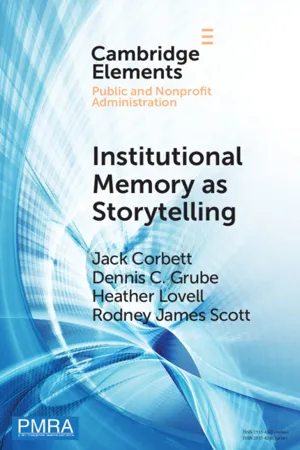
eBook - PDF
Institutional Memory as Storytelling
How Networked Government Remembers
- 78 pages
- English
- PDF
- Available on iOS & Android
eBook - PDF
Institutional Memory as Storytelling
How Networked Government Remembers
About this book
How do bureaucracies remember? The conventional view is that institutional memory is static and singular, the sum of recorded files and learned procedures. There is a growing body of scholarship that suggests contemporary bureaucracies are failing at this core task. This Element argues that this diagnosis misses that memories are essentially dynamic stories. They reside with people and are thus dispersed across the array of actors that make up the differentiated polity. Drawing on four policy examples from four sectors (housing, energy, family violence and justice) in three countries (the UK, Australia and New Zealand), this Element argues that treating the way institutions remember as storytelling is both empirically salient and normatively desirable. It is concluded that the current conceptualisation of institutional memory needs to be recalibrated to fit the types of policy learning practices required by modern collaborative governance.
Information
Table of contents
- Cover
- Title page
- Copyright page
- Institutional Memory as Storytelling: How Networked Government Remembers
- References
- Acknowledgments
Trusted by 375,005 students
Access to over 1.5 million titles for a fair monthly price.
Study more efficiently using our study tools.
Frequently asked questions
Yes, you can cancel anytime from the Subscription tab in your account settings on the Perlego website. Your subscription will stay active until the end of your current billing period. Learn how to cancel your subscription
No, books cannot be downloaded as external files, such as PDFs, for use outside of Perlego. However, you can download books within the Perlego app for offline reading on mobile or tablet. Learn how to download books offline
Perlego offers two plans: Essential and Complete
- Essential is ideal for learners and professionals who enjoy exploring a wide range of subjects. Access the Essential Library with 800,000+ trusted titles and best-sellers across business, personal growth, and the humanities. Includes unlimited reading time and Standard Read Aloud voice.
- Complete: Perfect for advanced learners and researchers needing full, unrestricted access. Unlock 1.5M+ books across hundreds of subjects, including academic and specialized titles. The Complete Plan also includes advanced features like Premium Read Aloud and Research Assistant.
We are an online textbook subscription service, where you can get access to an entire online library for less than the price of a single book per month. With over 1.5 million books across 990+ topics, we’ve got you covered! Learn about our mission
Look out for the read-aloud symbol on your next book to see if you can listen to it. The read-aloud tool reads text aloud for you, highlighting the text as it is being read. You can pause it, speed it up and slow it down. Learn more about Read Aloud
Yes! You can use the Perlego app on both iOS and Android devices to read anytime, anywhere — even offline. Perfect for commutes or when you’re on the go.
Please note we cannot support devices running on iOS 13 and Android 7 or earlier. Learn more about using the app
Please note we cannot support devices running on iOS 13 and Android 7 or earlier. Learn more about using the app
Yes, you can access Institutional Memory as Storytelling by Jack Corbett,Dennis Christian Grube,Heather Caroline Lovell,Rodney James Scott in PDF and/or ePUB format, as well as other popular books in Business & Organisational Behaviour. We have over 1.5 million books available in our catalogue for you to explore.