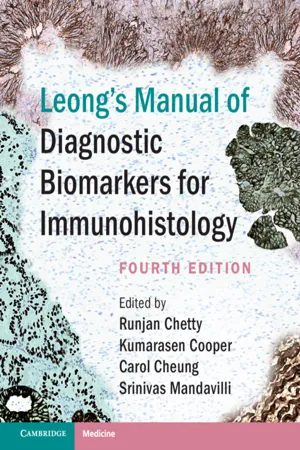
eBook - PDF
Leong's Manual of Diagnostic Biomarkers for Immunohistology
- 536 pages
- English
- PDF
- Available on iOS & Android
eBook - PDF
Leong's Manual of Diagnostic Biomarkers for Immunohistology
About this book
With the interest in biomarkers available for diagnostic, therapeutic, prognostic and research applications growing rapidly, it is now expected that every pathologist should be aware of the correct application of immunohistochemistry in daily practice. This fully updated fourth edition provides practical guidance about preparation, key uses and pitfalls of antibodies for immunohistology in a unique A-Z format. Seventeen full colour infographics present detail about specific biomarkers, including FOXL2, GATA3 and SOX10, pulling out information about expression in tissues and prognosis. Expanded with new biomarkers and the removal of biomarkers that are no longer in common use, each entry in this concise new edition follows a standard structure for quick and easy access by busy readers.
Information
Table of contents
- Cover
- Half-title page
- Title page
- Copyright page
- Dedication page
- Contents
- List of contributors
- Preface
- α-1-antitrypsin
- α-Fetoprotein (AFP)
- Alpha-1-antichymotrypsin
- Alpha methyl acyl CoA racemase (AMACR)
- Amyloid
- Anaplastic lymphoma kinase (ALK)
- Androgen receptor
- Anti-apoptosis
- Arginase-1
- ATRX (alpha-thalassemia/mental retardation syndrome X-linked)
- β-hCG (human chorionic gonadotropin)
- bcl-2
- bcl-6
- BCOR (bcl-6 interacting corepressor) and CIC-DUX4
- Ber-EP4
- BOB-1
- Brachyury
- CA125
- Calcitonin
- Calponin
- Calreticulin
- Calretinin
- Candida albicans
- Carbonic anhydrase IX
- Carcinoembryonic antigen (CEA)
- Catenins α, β, γ
- Cathepsin B, D, and K
- CD1A
- CD2
- CD3
- CD4
- CD5
- CD7
- CD8
- CD9
- CD10
- CD11
- CD15
- CD16
- CD19
- CD20
- CD21
- CD23
- CD24
- CD25
- CD30
- CD31
- CD33
- CD34
- CD35
- CD38
- CD40
- CD43
- CD44
- CD45 (leukocyte common antigen)
- CD45RA (4KB5, MB1, KiB3, and MT2)
- CD45RO (UCHL1, A6, OPD4)
- CD54 (ICAM-1)
- CD56 (neural cell adhesion molecule)
- CD57
- CD68
- CD71
- CD74
- CD79a
- CD99 (p30/32MIC2)
- CD103
- CD117 (KIT)
- CD123
- CD138
- CD163
- CDK4
- CDw75
- CDX2 (caudal type homeobox 2)
- c-erbB-2 (Her2, neu, CD340)
- Chlamydia
- Chromogranin
- Claudin-5
- c-Myc
- Collagen type IV
- CXCL13
- Cyclin D1 (bcl-1)
- Cytokeratins
- Cytokeratin 5/6 (CK 5/6)
- Cytokeratin 7 (CK 7)
- Cytokeratin 19 (CK 19)
- Cytokeratin 20 (CK 20)
- Cytokeratins: 34βE12
- Cytokeratins: AE1/AE3
- Cytokeratins: CAM 5.2
- Cytokeratins: MAK-6
- Cytokeratins: MNF 116
- Cytomegalovirus (CMV)
- Cytotoxic molecules (TIA-1, granzyme B, perforin)
- D2-40
- DBA.44 (hairy cell leukemia)
- Deleted in pancreatic cancer locus 4 (DPC4/SMAD4)
- Desmin
- Desmoplakins
- DOG-1
- E-cadherin/N/97-cadherin
- Epidermal growth factors: TGF-α and EGFR
- Epithelial membrane antigen
- Epstein–Barr virus, LMP
- ERG (avian v-ets erythroblastosis virus E26 oncogene homolog)
- Erythropoietin
- Estrogen receptor (ER)
- Factor VIII RA (von Willebrand factor)
- Factor Xllla
- Fas (CD95) and Fas-ligand (CD95 L)
- Fascin
- Ferritin
- Fibrin
- Fibrinogen
- Fibronectin
- FLI-1 protein
- FOXL2
- GATA 3 binding protein 3 (GATA3)
- Glial fibrillary acidic protein (GFAP)
- Glut-1
- Glypican-3
- Gross cystic disease fluid protein-15 (GCDFP-15, BRST-2)
- H3K27 M
- HAM56 (macrophage marker)
- HBME-1 (mesothelial cell marker)
- h-Caldesmon
- Heat shock proteins (HSPs)
- Helicobacter pylori
- Hep Par 1 (hepatocyte marker)
- Hepatitis B core antigen (HBcAg)
- Hepatitis B surface antigen (HBsAg)
- Herpes simplex virus I and II (HSV I and II)
- HHV-8 (human herpesvirus 8)
- HLA-DR
- HMB-45 (melanoma marker)
- hMLH1 and hMSH2 (mismatch repair proteins)
- Human immunodeficiency virus (HIV)
- Human milk fat globule (HMFG)
- Human papilloma virus (HPV)
- Human parvovirus B19
- Human placental lactogen (hPL)
- IDH1 and IDH2 (isocitrate dehydrogenase 1 and 2)
- IgG4
- Immunoglobulins: Igκ, Igλ, IgA, IgD, IgE, IgG, IgM
- Inhibin
- Insulinoma-associated 1
- Islet1
- Ki-67 (MIB1, Ki-S5)
- Laminin
- Lysozyme (muramidase)
- MAC 387
- MART-1/Melan-A
- Maspin
- MDM-2
- Measles
- Mel-CAM (melanoma cell adhesion molecule, CD146)
- Mesothelin
- Metallothioneins
- Microphthalmia transcription factor (MiTF)
- Mitochondria
- MLH1/MSH2 proteins
- MOC-31
- MSH6
- MUC2 (mucin 2)
- MUC4
- MUC5AC
- MUC6
- MUM-1 (interferon response factor 4, IRF4)
- Muscle-specific actin (MSA)
- Mycobacterial antigen
- Myelin basic protein (MBP)
- Myeloperoxidase
- MyoD1
- Myogenin
- Myoglobin
- Napsin-A
- Neurofilaments
- Neutrophil elastase
- NKX2.2
- nm23/NME1
- NTRK
- OCT2 (POU2F2)
- OCT4
- OLIG2 (oligodendrocyte transcription factor 2)
- Osteopontin
- p16
- p27kip1
- p40
- p53
- p63
- Pancreatic hormones (insulin, somatostatin, vasoactive intestinal polypeptide, gastrin, glucagon, pancreatic polypeptide)
- Parathyroid hormone
- Parathyroid hormone-related protein (PTHrP)
- PAX-2 (paired box gene 2)
- PAX-5
- PAX-8
- PDX1
- P-glycoprotein (P-170), multidrug resistance (MDR)
- Phosphohistone H3 (pHH3)
- Pituitary hormones (ACTH, FSH, hGH, LH, PRL, TSH)
- Placental alkaline phosphatase (PLAP)
- PMS2
- Pneumocystis carinii
- Pregnancy-specific β-1-glycoprotein (SP1)
- Progesterone receptor (PR)
- Programmed death-1
- Proliferating cell nuclear antigen (PCNA)
- Prostate-specific antigen (PSA)
- Prostatic acid phosphatase (PAP)
- pS2
- PTEN (phosphatase and tensin homolog deleted on chromosome 10)
- Rabies
- Retinoblastoma gene protein (P110Rb, Rb protein)
- S100
- SALL4
- SATB2
- Serotonin
- SF-1
- Simian virus 40 (SV40 T antigen)
- SMARCA4/BRG-1
- SMARCB1
- Smooth muscle actin (SMA)
- Smooth muscle myosin heavy chain
- SOX9
- SOX10
- Spectrin/Fodrin
- STAT6
- Surfactant apoprotein-A
- Synaptophysin
- TAG 72 (B72.3)
- Tau
- TCL1
- Tenascin
- Terminal deoxynucleotidyl transferase (TdT)
- TFE3
- Thrombomodulin
- Thyroglobulin
- Thyroid transcription factor-1 (TTF-1)
- TLE1
- Topoisomerase II alpha
- Toxoplasma gondii
- Tyrosinase
- Tyrosine hydroxylase
- Ubiquitin
- Ulex europaeus agglutinin 1 lectin (UEA-I)
- VEGF (vascular endothelial growth factor)
- Villin
- Vinculin
- VS38
- WT1
- Color plates can be found after page 504
Trusted by 375,005 students
Access to over 1.5 million titles for a fair monthly price.
Study more efficiently using our study tools.
Frequently asked questions
Yes, you can cancel anytime from the Subscription tab in your account settings on the Perlego website. Your subscription will stay active until the end of your current billing period. Learn how to cancel your subscription
No, books cannot be downloaded as external files, such as PDFs, for use outside of Perlego. However, you can download books within the Perlego app for offline reading on mobile or tablet. Learn how to download books offline
Perlego offers two plans: Essential and Complete
- Essential is ideal for learners and professionals who enjoy exploring a wide range of subjects. Access the Essential Library with 800,000+ trusted titles and best-sellers across business, personal growth, and the humanities. Includes unlimited reading time and Standard Read Aloud voice.
- Complete: Perfect for advanced learners and researchers needing full, unrestricted access. Unlock 1.5M+ books across hundreds of subjects, including academic and specialized titles. The Complete Plan also includes advanced features like Premium Read Aloud and Research Assistant.
We are an online textbook subscription service, where you can get access to an entire online library for less than the price of a single book per month. With over 1.5 million books across 990+ topics, we’ve got you covered! Learn about our mission
Look out for the read-aloud symbol on your next book to see if you can listen to it. The read-aloud tool reads text aloud for you, highlighting the text as it is being read. You can pause it, speed it up and slow it down. Learn more about Read Aloud
Yes! You can use the Perlego app on both iOS and Android devices to read anytime, anywhere — even offline. Perfect for commutes or when you’re on the go.
Please note we cannot support devices running on iOS 13 and Android 7 or earlier. Learn more about using the app
Please note we cannot support devices running on iOS 13 and Android 7 or earlier. Learn more about using the app
Yes, you can access Leong's Manual of Diagnostic Biomarkers for Immunohistology by Runjan Chetty,Kumarasen Cooper,Carol Cheung,Srinivas Mandavilli in PDF and/or ePUB format, as well as other popular books in Medicine & Pathology. We have over 1.5 million books available in our catalogue for you to explore.