- 98 pages
- English
- PDF
- Available on iOS & Android
eBook - PDF
The Economic Origin of Political Parties
About this book
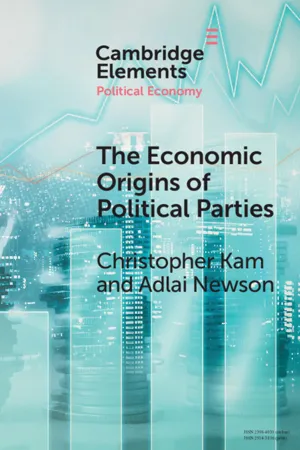
This Element examines how the changing economic basis of parliamentary elections in nineteenth century England and Wales contributed to the development of modern parties and elections. Even after the 1832 Reform Act expanded the British electorate, elections in many constituencies went uncontested, party labels were nominal, and candidates spent large sums treating and bribing voters. By the end of the century, however, almost every constituency was contested, candidates stood as representatives of national parties, and campaigns were fought on the basis of policies. We show how industrialization, the spread of literacy, and the rise of cheap newspapers, encouraged candidates to enter and contest constituencies. The increased expense that came from fighting frequent elections in larger constituencies induced co-partisan candidates to form slates. This imparted a uniform partisan character to parliamentary elections that facilitated the emergence of programmatic political parties.
Information
Table of contents
- Cover
- Title page
- Copyright page
- The Economic Origins of Political Parties
- Bibliography
- Acknowledgments
Trusted by 375,005 students
Access to over 1.5 million titles for a fair monthly price.
Study more efficiently using our study tools.
Frequently asked questions
Yes, you can cancel anytime from the Subscription tab in your account settings on the Perlego website. Your subscription will stay active until the end of your current billing period. Learn how to cancel your subscription
No, books cannot be downloaded as external files, such as PDFs, for use outside of Perlego. However, you can download books within the Perlego app for offline reading on mobile or tablet. Learn how to download books offline
Perlego offers two plans: Essential and Complete
- Essential is ideal for learners and professionals who enjoy exploring a wide range of subjects. Access the Essential Library with 800,000+ trusted titles and best-sellers across business, personal growth, and the humanities. Includes unlimited reading time and Standard Read Aloud voice.
- Complete: Perfect for advanced learners and researchers needing full, unrestricted access. Unlock 1.5M+ books across hundreds of subjects, including academic and specialized titles. The Complete Plan also includes advanced features like Premium Read Aloud and Research Assistant.
We are an online textbook subscription service, where you can get access to an entire online library for less than the price of a single book per month. With over 1.5 million books across 990+ topics, we’ve got you covered! Learn about our mission
Look out for the read-aloud symbol on your next book to see if you can listen to it. The read-aloud tool reads text aloud for you, highlighting the text as it is being read. You can pause it, speed it up and slow it down. Learn more about Read Aloud
Yes! You can use the Perlego app on both iOS and Android devices to read anytime, anywhere — even offline. Perfect for commutes or when you’re on the go.
Please note we cannot support devices running on iOS 13 and Android 7 or earlier. Learn more about using the app
Please note we cannot support devices running on iOS 13 and Android 7 or earlier. Learn more about using the app
Yes, you can access The Economic Origin of Political Parties by Christopher Kam,Adlai Newson in PDF and/or ePUB format, as well as other popular books in Economics & Political Economy. We have over 1.5 million books available in our catalogue for you to explore.