- 320 pages
- English
- PDF
- Available on iOS & Android
eBook - PDF
Institutions of Literature, 1700–1900
About this book
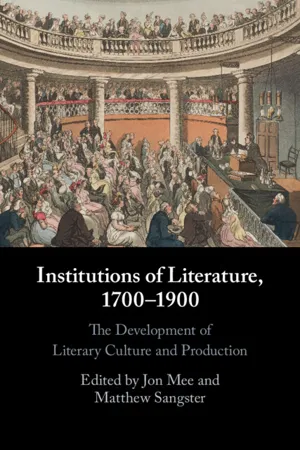
This collection provides students and researchers with a new and lively understanding of the role of institutions in the production, reception, and meaning of literature in the period 1700–1900. The period saw a fundamental transition from a patronage system to a marketplace in which institutions played an important mediating role between writers and readers, a shift with consequences that continue to resonate today. Often producers themselves, institutions processed and claimed authority over a variety of cultural domains that never simply tessellated into any unified system. The collection's primary concerns are British and imperial environments, with a comparative German case study, but it offers encouragement for its approaches to be taken up in a variety of other cultural contexts. From the Post Office to museums, from bricks and mortar to less tangible institutions like authorship and genre, this collection opens up a new field for literary studies.
Information
Table of contents
- Cover
- Half-title page
- Title page
- Copyright page
- Contents
- List of Figures
- List of Contributors
- Acknowledgements
- Introduction: Literature and Institutions
- Chapter 1 Knowledge Exchange in the Seventeenth Century: From the Third University to the Royal Society
- Chapter 2 ‘Supporting Mutual Benevolence’: Libraries, Civic Benefaction, and the Spalding Gentlemen’s Society, 1709–1755
- Chapter 3 Institutions without Addresses
- Chapter 4 Eighteenth-Century Musenhof Courts as Bridges and Brokers for Cultural Networks and Social Reform
- Chapter 5 Becoming Institutional: The Case of the Anacreontic Society
- Chapter 6 Circulating Libraries as Institutional Creators of Genres
- Chapter 7 Lecturing Networks and Cultural Institutions, 1740–1830
- Chapter 8 Catalogues as Instituting Genres of the Nineteenth-Century Museum: The Two Hunterians
- Chapter 9 Charles Lamb and the British Museum as an Institution of Literature
- Chapter 10 A Disruptive and Dangerous Education and the Wealth of the Nation: The Early Mechanics’ Institutes
- Chapter 11 ‘The Ladies’ Contribution’: Women and the Mechanics’ Institute on the Goldfields of Victoria
- Chapter 12 ‘[L]etters Must Increase’: Reading and Writing the Post Office as a Literary Institution
- Chapter 13 Networks, Nodes, and Beacons: Cultural Institutions in Nineteenth-Century Southeast Asia
- Chapter 14 The Book as Medium
- Index
Trusted by 375,005 students
Access to over 1.5 million titles for a fair monthly price.
Study more efficiently using our study tools.
Frequently asked questions
Yes, you can cancel anytime from the Subscription tab in your account settings on the Perlego website. Your subscription will stay active until the end of your current billing period. Learn how to cancel your subscription
No, books cannot be downloaded as external files, such as PDFs, for use outside of Perlego. However, you can download books within the Perlego app for offline reading on mobile or tablet. Learn how to download books offline
Perlego offers two plans: Essential and Complete
- Essential is ideal for learners and professionals who enjoy exploring a wide range of subjects. Access the Essential Library with 800,000+ trusted titles and best-sellers across business, personal growth, and the humanities. Includes unlimited reading time and Standard Read Aloud voice.
- Complete: Perfect for advanced learners and researchers needing full, unrestricted access. Unlock 1.5M+ books across hundreds of subjects, including academic and specialized titles. The Complete Plan also includes advanced features like Premium Read Aloud and Research Assistant.
We are an online textbook subscription service, where you can get access to an entire online library for less than the price of a single book per month. With over 1.5 million books across 990+ topics, we’ve got you covered! Learn about our mission
Look out for the read-aloud symbol on your next book to see if you can listen to it. The read-aloud tool reads text aloud for you, highlighting the text as it is being read. You can pause it, speed it up and slow it down. Learn more about Read Aloud
Yes! You can use the Perlego app on both iOS and Android devices to read anytime, anywhere — even offline. Perfect for commutes or when you’re on the go.
Please note we cannot support devices running on iOS 13 and Android 7 or earlier. Learn more about using the app
Please note we cannot support devices running on iOS 13 and Android 7 or earlier. Learn more about using the app
Yes, you can access Institutions of Literature, 1700–1900 by Jon Mee,Matthew Sangster in PDF and/or ePUB format, as well as other popular books in Languages & Linguistics & Publishing. We have over 1.5 million books available in our catalogue for you to explore.