- 266 pages
- English
- PDF
- Available on iOS & Android
eBook - PDF
About this book
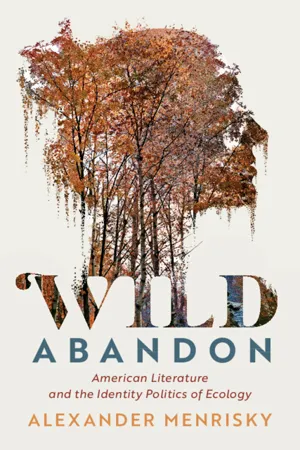
The American wilderness narrative, which divides nature from culture, has remained remarkably persistent despite the rise of ecological science, which emphasizes interconnection between these spheres. Wild Abandon considers how ecology's interaction with radical politics of authenticity in the twentieth century has kept that narrative alive in altered form. As ecology gained political momentum in the 1960s and 1970s, many environmentalists combined it with ideas borrowed from psychoanalysis and a variety of identity-based social movements. The result was an identity politics of ecology that framed ecology itself as an authentic identity position repressed by cultural forms, including social differences and even selfhood. Through readings of texts by Edward Abbey, Simon Ortiz, Toni Morrison, Margaret Atwood, and Jon Krakauer, among others, Alexander Menrisky argues that writers have both dramatized and critiqued this tendency, in the process undermining the concept of authenticity altogether and granting insight into alternative histories of identity and environment.
Information
Table of contents
- Cover
- Half-title page
- Series page
- Title page
- Copyright page
- Contents
- Acknowledgments
- Introduction Modern Environmentalism’s Identity Politics
- Chapter 1 The Ecological Alternative: Civilization, Selfhood, and Environment in the 1960s
- Chapter 2 The Entheogenic Landscape: Psychedelic Primitives, Ecological Indians, and the American Counterculture
- Chapter 3 The Universal Wilderness: Race, Cultural Nationalism, and an Identity Politics for the State of Nature
- Chapter 4 The Essential Ecosystem: Reproduction, Network, and Biological Reduction
- Chapter 5 The Death of the Supertramp: Psychoanalytic Narratives and American Wilderness
- Conclusion Ecological Consistency
- Notes
- Bibliography
- Index
Trusted by 375,005 students
Access to over 1.5 million titles for a fair monthly price.
Study more efficiently using our study tools.
Frequently asked questions
Yes, you can cancel anytime from the Subscription tab in your account settings on the Perlego website. Your subscription will stay active until the end of your current billing period. Learn how to cancel your subscription
No, books cannot be downloaded as external files, such as PDFs, for use outside of Perlego. However, you can download books within the Perlego app for offline reading on mobile or tablet. Learn how to download books offline
Perlego offers two plans: Essential and Complete
- Essential is ideal for learners and professionals who enjoy exploring a wide range of subjects. Access the Essential Library with 800,000+ trusted titles and best-sellers across business, personal growth, and the humanities. Includes unlimited reading time and Standard Read Aloud voice.
- Complete: Perfect for advanced learners and researchers needing full, unrestricted access. Unlock 1.5M+ books across hundreds of subjects, including academic and specialized titles. The Complete Plan also includes advanced features like Premium Read Aloud and Research Assistant.
We are an online textbook subscription service, where you can get access to an entire online library for less than the price of a single book per month. With over 1.5 million books across 990+ topics, we’ve got you covered! Learn about our mission
Look out for the read-aloud symbol on your next book to see if you can listen to it. The read-aloud tool reads text aloud for you, highlighting the text as it is being read. You can pause it, speed it up and slow it down. Learn more about Read Aloud
Yes! You can use the Perlego app on both iOS and Android devices to read anytime, anywhere — even offline. Perfect for commutes or when you’re on the go.
Please note we cannot support devices running on iOS 13 and Android 7 or earlier. Learn more about using the app
Please note we cannot support devices running on iOS 13 and Android 7 or earlier. Learn more about using the app
Yes, you can access Wild Abandon by Alexander Menrisky in PDF and/or ePUB format, as well as other popular books in Literature & North American Literary Criticism. We have over 1.5 million books available in our catalogue for you to explore.