eBook - PDF
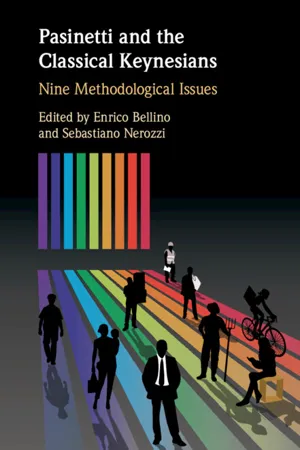
Pasinetti and the Classical Keynesians
Nine Methodological Issues
- 346 pages
- English
- PDF
- Available on iOS & Android
eBook - PDF
About this book
Recent economic and financial crises have exposed mainstream economics to severe criticism, bringing present research and teaching styles into question. Building on a solid and vivid tradition of economic thought, this book challenges conventional thinking in the field of economics. The authors turn to the work of Luigi Pasinetti, who proposed a list of nine methodological and theoretical ideas that characterize the Classical Keynesian School. Drawing inspiration from both Keynes and Sraffa, this school has forged a long-standing and ambitious research programme often advocated as a competing paradigm to mainstream economics. Overall, the Classical Keynesian School provides a comprehensive analytical framework into which most non-mainstream schools of thought can be integrated. In this collection, a group of leading scholars critically assess the nine main ideas that, in Pasinetti's view, characterize the Classical-Keynesian approach, evaluating their relevance for both the history of economics and for present economic research.
Information
Table of contents
- Cover
- Half-title
- Title page
- Copyright information
- Contents
- List of Contributors
- Foreword: The Political Economy of Luigi Pasinetti
- Introduction
- 1 Reality (and Not Simply Abstract Rationality) as the Starting Point of Economic Theory
- 2 Economic Logic with Internal Consistency (and Not Only Formal Rigour): Realism and Internal Consistency in Piero Sraffa
- 3 Malthus and the Classics (Not Walras and the Marginalists) as the Major Inspiring Source in the History of Economic Thought: The Principle of Effective Demand and Classical Economics
- 4 Non-ergodic (in Place of Stationary, Timeless) Economic Systems: Considerations Suggested by Joan Robinson's Distinction between Two 'Notions' of Time in Economic Theory
- 5 Causality vs. Interdependence: A Distinction That Conveys a World's View
- 6 Macroeconomics before Microeconomics: A Sceptic's Guide to Macroeconomics
- 7 Disequilibrium and Instability (Not Equilibrium) as the Normal State of the Industrial Economies: A Methodological Standpoint on Structural Economic Dynamics
- 8 Necessity of Finding an Appropriate Analytical Framework for Dealing with Technical Change and Economic Growth: Technical Change, Structural Dynamics and Employment
- 9 A Strong, Deeply Felt, Social Concern
- 10 Why the Classic-Keynesian Trend May Be of Interest to a Young Scholar Today
- 11 Pasinetti's Separation Theorem
- Author Index
Trusted by 375,005 students
Access to over 1.5 million titles for a fair monthly price.
Study more efficiently using our study tools.
Frequently asked questions
Yes, you can cancel anytime from the Subscription tab in your account settings on the Perlego website. Your subscription will stay active until the end of your current billing period. Learn how to cancel your subscription
No, books cannot be downloaded as external files, such as PDFs, for use outside of Perlego. However, you can download books within the Perlego app for offline reading on mobile or tablet. Learn how to download books offline
Perlego offers two plans: Essential and Complete
- Essential is ideal for learners and professionals who enjoy exploring a wide range of subjects. Access the Essential Library with 800,000+ trusted titles and best-sellers across business, personal growth, and the humanities. Includes unlimited reading time and Standard Read Aloud voice.
- Complete: Perfect for advanced learners and researchers needing full, unrestricted access. Unlock 1.5M+ books across hundreds of subjects, including academic and specialized titles. The Complete Plan also includes advanced features like Premium Read Aloud and Research Assistant.
We are an online textbook subscription service, where you can get access to an entire online library for less than the price of a single book per month. With over 1.5 million books across 990+ topics, we’ve got you covered! Learn about our mission
Look out for the read-aloud symbol on your next book to see if you can listen to it. The read-aloud tool reads text aloud for you, highlighting the text as it is being read. You can pause it, speed it up and slow it down. Learn more about Read Aloud
Yes! You can use the Perlego app on both iOS and Android devices to read anytime, anywhere — even offline. Perfect for commutes or when you’re on the go.
Please note we cannot support devices running on iOS 13 and Android 7 or earlier. Learn more about using the app
Please note we cannot support devices running on iOS 13 and Android 7 or earlier. Learn more about using the app
Yes, you can access Pasinetti and the Classical Keynesians by Enrico Bellino,Sebastiano Nerozzi in PDF and/or ePUB format, as well as other popular books in Economics & Economic History. We have over 1.5 million books available in our catalogue for you to explore.