- 254 pages
- English
- PDF
- Available on iOS & Android
eBook - PDF
About this book
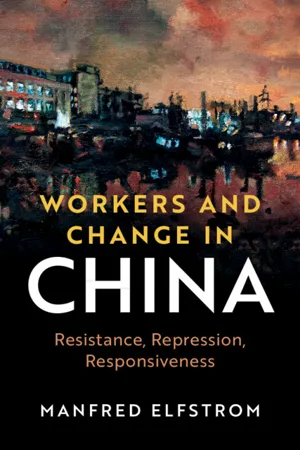
Strikes, protests, and riots by Chinese workers have been rising over the past decade. The state has addressed a number of grievances, yet has also come down increasingly hard on civil society groups pushing for reform. Why are these two seemingly clashing developments occurring simultaneously? Manfred Elfstrom uses extensive fieldwork and statistical analysis to examine both the causes and consequences of protest. The book adopts a holistic approach, encompassing national trends in worker–state relations, local policymaking processes and the dilemmas of individual officials and activists. Instead of taking sides in the old debate over whether non-democracies like China's are on the verge of collapse or have instead found ways of maintaining their power indefinitely, it explores the daily evolution of autocratic rule. While providing a uniquely comprehensive picture of change in China, this important study proposes a new model of bottom-up change within authoritarian systems more generally.
Information
Table of contents
- Cover
- Half-title
- Series information
- Title page
- Copyright information
- Dedication
- Contents
- List of Figures
- List of Maps
- List of Tables
- Acknowledgments
- 1 Introduction
- 2 Recipes for Resistance
- 3 Bureaucratic Incentives
- 4 Orthodox Control
- 5 Risk-Taking Control
- 6 Increased Repressive and Responsive Capacity
- 7 Bottom-Up versus Top-Down Change
- 8 Conclusion
- Appendices
- References
- Index
Trusted by 375,005 students
Access to over 1.5 million titles for a fair monthly price.
Study more efficiently using our study tools.
Frequently asked questions
Yes, you can cancel anytime from the Subscription tab in your account settings on the Perlego website. Your subscription will stay active until the end of your current billing period. Learn how to cancel your subscription
No, books cannot be downloaded as external files, such as PDFs, for use outside of Perlego. However, you can download books within the Perlego app for offline reading on mobile or tablet. Learn how to download books offline
Perlego offers two plans: Essential and Complete
- Essential is ideal for learners and professionals who enjoy exploring a wide range of subjects. Access the Essential Library with 800,000+ trusted titles and best-sellers across business, personal growth, and the humanities. Includes unlimited reading time and Standard Read Aloud voice.
- Complete: Perfect for advanced learners and researchers needing full, unrestricted access. Unlock 1.5M+ books across hundreds of subjects, including academic and specialized titles. The Complete Plan also includes advanced features like Premium Read Aloud and Research Assistant.
We are an online textbook subscription service, where you can get access to an entire online library for less than the price of a single book per month. With over 1.5 million books across 990+ topics, we’ve got you covered! Learn about our mission
Look out for the read-aloud symbol on your next book to see if you can listen to it. The read-aloud tool reads text aloud for you, highlighting the text as it is being read. You can pause it, speed it up and slow it down. Learn more about Read Aloud
Yes! You can use the Perlego app on both iOS and Android devices to read anytime, anywhere — even offline. Perfect for commutes or when you’re on the go.
Please note we cannot support devices running on iOS 13 and Android 7 or earlier. Learn more about using the app
Please note we cannot support devices running on iOS 13 and Android 7 or earlier. Learn more about using the app
Yes, you can access Workers and Change in China by Manfred Elfstrom in PDF and/or ePUB format, as well as other popular books in Politics & International Relations & Global Politics. We have over 1.5 million books available in our catalogue for you to explore.