- 348 pages
- English
- PDF
- Available on iOS & Android
eBook - PDF
Tragedy and Postcolonial Literature
About this book
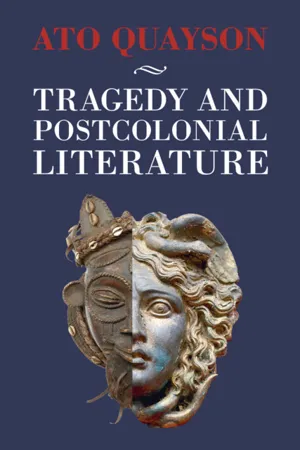
This book examines tragedy and tragic philosophy from the Greeks through Shakespeare to the present day. It explores key themes in the links between suffering and ethics through postcolonial literature. Ato Quayson reconceives how we think of World literature under the singular and fertile rubric of tragedy. He draws from many key works – Oedipus Rex, Philoctetes, Medea, Hamlet, Macbeth, and King Lear – to establish the main contours of tragedy. Quayson uses Shakespeare's Othello, Chinua Achebe, Wole Soyinka, Tayeb Salih, Arundhati Roy, Toni Morrison, Samuel Beckett and J.M. Coetzee to qualify and expand the purview and terms by which Western tragedy has long been understood. Drawing on key texts such as The Poetics and The Nicomachean Ethics, and augmenting them with Frantz Fanon and the Akan concept of musuo (taboo), Quayson formulates a supple, insightful new theory of ethical choice and the impediments against it. This is a major book from a leading critic in literary studies.
Information
Table of contents
- Cover
- Half-title page
- Title page
- Copyright page
- Dedication
- Contents
- Preface and Acknowledgments
- Chapter 1 Introduction: Tragedy and the Maze of Moments
- Chapter 2 Ethical Cosmopolitanism and Shakespeare’s Othello
- Chapter 3 History and the Conscription to Colonial Modernity in Chinua Achebe’s Rural Novels
- Chapter 4 Ritual Dramaturgy and the Social Imaginary in Wole Soyinka’s Tragic Theatre
- Chapter 5 Archetypes, Self-Authorship, and Melancholia: Tayeb Salih’s Seasons of Migration to the North
- Chapter 6 Form, Freedom, and Ethical Choice in Toni Morrison’s Beloved
- Chapter 7 On Moral Residue and the Affliction of Second Thoughts: J. M. Coetzee’s Waiting for the Barbarians
- Chapter 8 Enigmatic Variations, Language Games, and the Arrested Bildungsroman: Arundhati Roy’s The God of Small Things
- Chapter 9 Distressed Embodiment and the Burdens of Boredom: Samuel Beckett’s Postcolonialism
- Chapter 10 Conclusion: Postcolonial Tragedy and the Question of Method
- Bibliography
- Index
Trusted by 375,005 students
Access to over 1.5 million titles for a fair monthly price.
Study more efficiently using our study tools.
Frequently asked questions
Yes, you can cancel anytime from the Subscription tab in your account settings on the Perlego website. Your subscription will stay active until the end of your current billing period. Learn how to cancel your subscription
No, books cannot be downloaded as external files, such as PDFs, for use outside of Perlego. However, you can download books within the Perlego app for offline reading on mobile or tablet. Learn how to download books offline
Perlego offers two plans: Essential and Complete
- Essential is ideal for learners and professionals who enjoy exploring a wide range of subjects. Access the Essential Library with 800,000+ trusted titles and best-sellers across business, personal growth, and the humanities. Includes unlimited reading time and Standard Read Aloud voice.
- Complete: Perfect for advanced learners and researchers needing full, unrestricted access. Unlock 1.5M+ books across hundreds of subjects, including academic and specialized titles. The Complete Plan also includes advanced features like Premium Read Aloud and Research Assistant.
We are an online textbook subscription service, where you can get access to an entire online library for less than the price of a single book per month. With over 1.5 million books across 990+ topics, we’ve got you covered! Learn about our mission
Look out for the read-aloud symbol on your next book to see if you can listen to it. The read-aloud tool reads text aloud for you, highlighting the text as it is being read. You can pause it, speed it up and slow it down. Learn more about Read Aloud
Yes! You can use the Perlego app on both iOS and Android devices to read anytime, anywhere — even offline. Perfect for commutes or when you’re on the go.
Please note we cannot support devices running on iOS 13 and Android 7 or earlier. Learn more about using the app
Please note we cannot support devices running on iOS 13 and Android 7 or earlier. Learn more about using the app
Yes, you can access Tragedy and Postcolonial Literature by Ato Quayson in PDF and/or ePUB format, as well as other popular books in Literature & Literary Criticism Theory. We have over 1.5 million books available in our catalogue for you to explore.