- 398 pages
- English
- PDF
- Available on iOS & Android
eBook - PDF
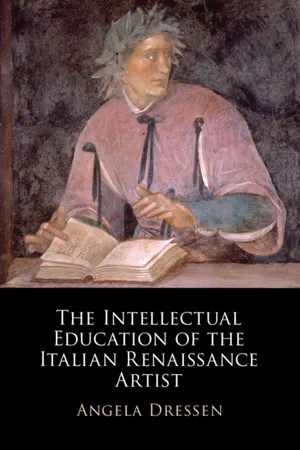
The Intellectual Education of the Italian Renaissance Artist
About this book
Scholars have traditionally viewed the Italian Renaissance artist as a gifted, but poorly educated craftsman whose complex and demanding works were created with the assistance of a more educated advisor. These assumptions are, in part, based on research that has focused primarily on the artist's social rank and workshop training. In this volume, Angela Dressen explores the range of educational opportunities that were available to the Italian Renaissance artist. Considering artistic formation within the history of education, Dressen focuses on the training of highly skilled, average artists, revealing a general level of learning that was much more substantial than has been assumed. She emphasizes the role of mediators who had a particular interest in augmenting artists' knowledge, and highlights how artists used Latin and vernacular texts to gain additional knowledge that they avidly sought. Dressen's volume brings new insights into a topic at the intersection of early modern intellectual, educational, and art history.
Information
Topic
ArtSubtopic
Art GeneralTable of contents
- Cover
- Half-title
- Title page
- Copyright information
- Contents
- List of Illustrations
- Preface
- Introduction
- One Mechanical Arts versus Liberal Arts and Recommendations for the Artist's Education
- Two Educational Places and Opportunities
- Three The Mediating Texts
- Four Vitruvius and Pliny as Sourcebooks, Educational Landmarks, and Intellectual Challenge
- Conclusion
- Appendix A Printed Editions as Editio Princeps and Shortly after, Divided by Editions, Translations, and Commentaries
- Appendix B Oral Lessons in Private and Public Environments
- Selected Bibliography
- Index
Trusted by 375,005 students
Access to over 1.5 million titles for a fair monthly price.
Study more efficiently using our study tools.
Frequently asked questions
Yes, you can cancel anytime from the Subscription tab in your account settings on the Perlego website. Your subscription will stay active until the end of your current billing period. Learn how to cancel your subscription
No, books cannot be downloaded as external files, such as PDFs, for use outside of Perlego. However, you can download books within the Perlego app for offline reading on mobile or tablet. Learn how to download books offline
Perlego offers two plans: Essential and Complete
- Essential is ideal for learners and professionals who enjoy exploring a wide range of subjects. Access the Essential Library with 800,000+ trusted titles and best-sellers across business, personal growth, and the humanities. Includes unlimited reading time and Standard Read Aloud voice.
- Complete: Perfect for advanced learners and researchers needing full, unrestricted access. Unlock 1.5M+ books across hundreds of subjects, including academic and specialized titles. The Complete Plan also includes advanced features like Premium Read Aloud and Research Assistant.
We are an online textbook subscription service, where you can get access to an entire online library for less than the price of a single book per month. With over 1.5 million books across 990+ topics, we’ve got you covered! Learn about our mission
Look out for the read-aloud symbol on your next book to see if you can listen to it. The read-aloud tool reads text aloud for you, highlighting the text as it is being read. You can pause it, speed it up and slow it down. Learn more about Read Aloud
Yes! You can use the Perlego app on both iOS and Android devices to read anytime, anywhere — even offline. Perfect for commutes or when you’re on the go.
Please note we cannot support devices running on iOS 13 and Android 7 or earlier. Learn more about using the app
Please note we cannot support devices running on iOS 13 and Android 7 or earlier. Learn more about using the app
Yes, you can access The Intellectual Education of the Italian Renaissance Artist by Angela Dressen in PDF and/or ePUB format, as well as other popular books in Art & Art General. We have over 1.5 million books available in our catalogue for you to explore.