- 712 pages
- English
- PDF
- Available on iOS & Android
eBook - PDF
Primate Cognitive Studies
About this book
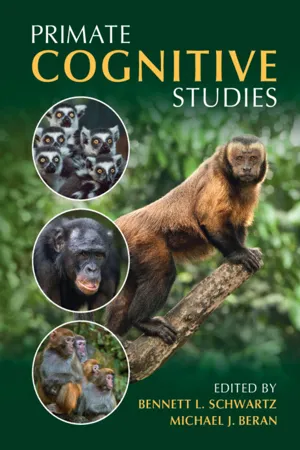
Researchers have studied non-human primate cognition along different paths, including social cognition, planning and causal knowledge, spatial cognition and memory, and gestural communication, as well as comparative studies with humans. This volume describes how primate cognition is studied in labs, zoos, sanctuaries, and in the field, bringing together researchers examining similar issues in all of these settings and showing how each benefits from the others. Readers will discover how lab-based concepts play out in the real world of free primates. This book tackles pressing issues such as replicability, research ethics, and open science. With contributors from a broad range of comparative, cognitive, neuroscience, developmental, ecological, and ethological perspectives, the volume provides a state-of-the-art review pointing to new avenues for integrative research.
Information
Table of contents
- Cover
- Half-title
- Title Page
- Copyright Imformation
- Contents
- List of Figures
- List of Tables
- List of Contributors
- Acknowledgments
- 1 The Purpose of Primate Cognitive Studies
- 2 A History of Primates Studying Primates
- 3 Genetic and Environmental Influences on Chimpanzee Brain and Cognition
- 4 The Evolution of Cognition in Primates, Including Humans
- 5 State of the Field: Developmental Primate Cognition
- 6 Current Perspectives on Primate Perception
- 7 The Comparative Study of Categorization
- 8 Numerical Cognition in Nonhuman Primates
- 9 The Natural History of Primate Spatial Cognition: An Organismic Perspective
- 10 Progress and Prospects in Primate Tool Use and Cognition
- 11 Sequencing, Artificial Grammar, and Recursion in Primates
- 12 The Evolution of Episodic Cognition: The Sense of Time
- 13 Metacognition
- 14 Bridging the Conceptual Gap between Inferential Reasoning and Problem Solving in Primates
- 15 The Eyes Have It: Using Non-Invasive Eye Tracking to Advance Comparative Social Cognition Research
- 16 Social Cooperation in Primates
- 17 Primate Communication: Affective, Intentional, or Both?
- 18 Theory of Mind in Nonhuman Primates
- 19 A Requiem for Ape Language Research: The Cognitive Foundations of Language
- 20 Primate Empathy: A Flexible and Multi-Componential Phenomenon
- 21 Replication and Reproducibility in Primate Cognition Research
- 22 Ethical Considerations in Conducting Primate Cognition Research
- 23 Collaboration and Open Science Initiatives in Primate Research
- 24 Studying Primate Cognition: From the Wild to Captivity and Back
- 25 Do Monkeys Belong in the Ape House? Comparing Cognition across Primate Species
- Index
Trusted by 375,005 students
Access to over 1.5 million titles for a fair monthly price.
Study more efficiently using our study tools.
Frequently asked questions
Yes, you can cancel anytime from the Subscription tab in your account settings on the Perlego website. Your subscription will stay active until the end of your current billing period. Learn how to cancel your subscription
No, books cannot be downloaded as external files, such as PDFs, for use outside of Perlego. However, you can download books within the Perlego app for offline reading on mobile or tablet. Learn how to download books offline
Perlego offers two plans: Essential and Complete
- Essential is ideal for learners and professionals who enjoy exploring a wide range of subjects. Access the Essential Library with 800,000+ trusted titles and best-sellers across business, personal growth, and the humanities. Includes unlimited reading time and Standard Read Aloud voice.
- Complete: Perfect for advanced learners and researchers needing full, unrestricted access. Unlock 1.5M+ books across hundreds of subjects, including academic and specialized titles. The Complete Plan also includes advanced features like Premium Read Aloud and Research Assistant.
We are an online textbook subscription service, where you can get access to an entire online library for less than the price of a single book per month. With over 1.5 million books across 990+ topics, we’ve got you covered! Learn about our mission
Look out for the read-aloud symbol on your next book to see if you can listen to it. The read-aloud tool reads text aloud for you, highlighting the text as it is being read. You can pause it, speed it up and slow it down. Learn more about Read Aloud
Yes! You can use the Perlego app on both iOS and Android devices to read anytime, anywhere — even offline. Perfect for commutes or when you’re on the go.
Please note we cannot support devices running on iOS 13 and Android 7 or earlier. Learn more about using the app
Please note we cannot support devices running on iOS 13 and Android 7 or earlier. Learn more about using the app
Yes, you can access Primate Cognitive Studies by Bennett L. Schwartz,Michael J. Beran in PDF and/or ePUB format, as well as other popular books in Psychology & Cognitive Psychology & Cognition. We have over 1.5 million books available in our catalogue for you to explore.