eBook - PDF
State and Family in China
About this book
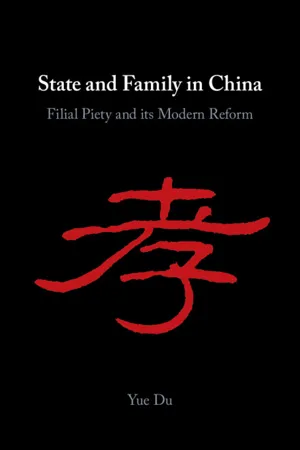
In Imperial China, the idea of filial piety not only shaped family relations but was also the official ideology by which Qing China was governed. In State and Family in China, Yue Du examines the relationship between politics and intergenerational family relations in China from the Qing period to 1949, focusing on changes in family law, parent-child relationships, and the changing nature of the Chinese state during this period. This book highlights how the Qing dynasty treated the state-sponsored parent-child hierarchy as the axis around which Chinese family and political power relations were constructed and maintained. It shows how following the fall of the Qing in 1911, reform of filial piety law in the Republic of China became the basis of state-directed family reform, playing a central role in China's transition from empire to nation-state.
Information
Table of contents
- Cover
- Half-title page
- Title page
- Copyright page
- Epigraph
- Contents
- Preface
- List of Abbreviations
- Introduction: Filial Piety beyond Confucianism
- Part I Ruling the Empire through the Principle of Filiality
- Part II Building the Nation through Restructuring the Family
- Conclusion: Filial Piety toward the State
- Glossary
- Bibliography
- Index
Trusted by 375,005 students
Access to over 1.5 million titles for a fair monthly price.
Study more efficiently using our study tools.
Frequently asked questions
Yes, you can cancel anytime from the Subscription tab in your account settings on the Perlego website. Your subscription will stay active until the end of your current billing period. Learn how to cancel your subscription
No, books cannot be downloaded as external files, such as PDFs, for use outside of Perlego. However, you can download books within the Perlego app for offline reading on mobile or tablet. Learn how to download books offline
We are an online textbook subscription service, where you can get access to an entire online library for less than the price of a single book per month. With over 1.5 million books across 990+ topics, we’ve got you covered! Learn about our mission
Look out for the read-aloud symbol on your next book to see if you can listen to it. The read-aloud tool reads text aloud for you, highlighting the text as it is being read. You can pause it, speed it up and slow it down. Learn more about Read Aloud
Yes! You can use the Perlego app on both iOS and Android devices to read anytime, anywhere — even offline. Perfect for commutes or when you’re on the go.
Please note we cannot support devices running on iOS 13 and Android 7 or earlier. Learn more about using the app
Please note we cannot support devices running on iOS 13 and Android 7 or earlier. Learn more about using the app
Yes, you can access State and Family in China by Yue Du in PDF and/or ePUB format, as well as other popular books in History & Asian History. We have over 1.5 million books available in our catalogue for you to explore.