eBook - PDF
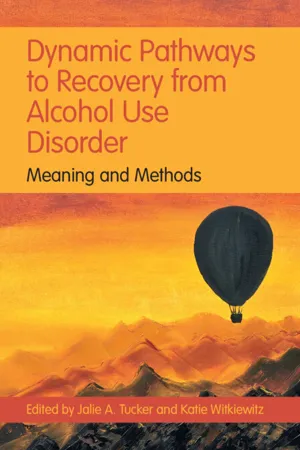
Dynamic Pathways to Recovery from Alcohol Use Disorder
Meaning and Methods
- 468 pages
- English
- PDF
- Available on iOS & Android
eBook - PDF
Dynamic Pathways to Recovery from Alcohol Use Disorder
Meaning and Methods
About this book
Alcohol use disorder is by far the most prevalent substance use disorder in the general population and is a major contributor to disease worldwide. Recovery from the disorder is a dynamic process of change, and individuals take many different routes to resolve their alcohol problems and seek to achieve a life worth living. Total abstention is not the only solution and robust recovery involves more than changing drinking practices. This volume brings together multidisciplinary research on recovery processes, contexts, and outcomes as well as new ideas about the multiple pathways involved. Experts chart the individual, social, contextual, community, economic, regulatory, policy, and structural influences that are vital to understanding alcohol use disorder and recovery. The book recommends new approaches to conceptualizing and assessing recovery alongside new avenues for research, community engagement, and policy that constitute a major shift in the practice and policy landscape.
Information
Table of contents
- Cover
- Half-title
- Title page
- Copyright information
- Dedication
- Contents
- List of Figures
- List of Tables
- List of Contributors
- Foreword
- Preface
- Acknowledgments
- Introduction
- 1 Historical and Contemporary Perspectives on Pathways to Recovery from Alcohol Use Disorder
- Part I Micro Level: The Individual as Change Agent
- Part II Meso Level: Understanding and Promoting Individual Behavior Change within Natural Environments
- Part III Macro Level: Creating Environments, Resources, Incentives, and Policies to Promote Harm Reduction and Recovery
- Conclusions and Future Directions
- Index
Trusted by 375,005 students
Access to over 1.5 million titles for a fair monthly price.
Study more efficiently using our study tools.
Frequently asked questions
Yes, you can cancel anytime from the Subscription tab in your account settings on the Perlego website. Your subscription will stay active until the end of your current billing period. Learn how to cancel your subscription
No, books cannot be downloaded as external files, such as PDFs, for use outside of Perlego. However, you can download books within the Perlego app for offline reading on mobile or tablet. Learn how to download books offline
We are an online textbook subscription service, where you can get access to an entire online library for less than the price of a single book per month. With over 1.5 million books across 990+ topics, we’ve got you covered! Learn about our mission
Look out for the read-aloud symbol on your next book to see if you can listen to it. The read-aloud tool reads text aloud for you, highlighting the text as it is being read. You can pause it, speed it up and slow it down. Learn more about Read Aloud
Yes! You can use the Perlego app on both iOS and Android devices to read anytime, anywhere — even offline. Perfect for commutes or when you’re on the go.
Please note we cannot support devices running on iOS 13 and Android 7 or earlier. Learn more about using the app
Please note we cannot support devices running on iOS 13 and Android 7 or earlier. Learn more about using the app
Yes, you can access Dynamic Pathways to Recovery from Alcohol Use Disorder by Jalie A. Tucker,Katie Witkiewitz in PDF and/or ePUB format, as well as other popular books in Psychology & Clinical Psychology. We have over 1.5 million books available in our catalogue for you to explore.