- 346 pages
- English
- PDF
- Available on iOS & Android
eBook - PDF
About this book
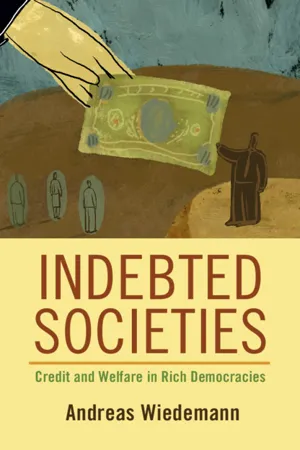
In many rich democracies, access to financial markets is now a prerequisite for fully participating in labor and housing markets and pursuing educational opportunities. Indebted Societies introduces a new social policy theory of everyday borrowing to examine how the rise of credit as a private alternative to the welfare state creates a new kind of social and economic citizenship. Andreas Wiedemann provides a rich study of income volatility and rising household indebtedness across OECD countries. Weaker social policies and a flexible knowledge economy have increased costs for housing, education, and raising a family - forcing many people into debt. By highlighting how credit markets interact with welfare states, the book helps explain why similar groups of people are more indebted in some countries than others. Moreover, it addresses the fundamental question of whether individuals, states, or markets should be responsible for addressing socio-economic risks and providing social opportunities.
Information
Table of contents
- Cover
- Half-title page
- Series page
- Title page
- Copyright page
- Contents
- List of Figures
- List of Tables
- Acknowledgments
- 1 Credit and Welfare in Rich Democracies
- 2 A Social Policy Theory of Everyday Borrowing
- 3 Financial Shortfalls and the Role of Welfare States
- 4 Credit Regimes and Patterns of Household Indebtedness
- 5 Borrowing to Address Labor Market Risks
- 6 Borrowing during the Life Course
- 7 The Political and Socioeconomic Consequences of Credit and Debt
- 8 Implications and Conclusion
- Appendix
- Bibliography
- Index
Trusted by 375,005 students
Access to over 1.5 million titles for a fair monthly price.
Study more efficiently using our study tools.
Frequently asked questions
Yes, you can cancel anytime from the Subscription tab in your account settings on the Perlego website. Your subscription will stay active until the end of your current billing period. Learn how to cancel your subscription
No, books cannot be downloaded as external files, such as PDFs, for use outside of Perlego. However, you can download books within the Perlego app for offline reading on mobile or tablet. Learn how to download books offline
Perlego offers two plans: Essential and Complete
- Essential is ideal for learners and professionals who enjoy exploring a wide range of subjects. Access the Essential Library with 800,000+ trusted titles and best-sellers across business, personal growth, and the humanities. Includes unlimited reading time and Standard Read Aloud voice.
- Complete: Perfect for advanced learners and researchers needing full, unrestricted access. Unlock 1.5M+ books across hundreds of subjects, including academic and specialized titles. The Complete Plan also includes advanced features like Premium Read Aloud and Research Assistant.
We are an online textbook subscription service, where you can get access to an entire online library for less than the price of a single book per month. With over 1.5 million books across 990+ topics, we’ve got you covered! Learn about our mission
Look out for the read-aloud symbol on your next book to see if you can listen to it. The read-aloud tool reads text aloud for you, highlighting the text as it is being read. You can pause it, speed it up and slow it down. Learn more about Read Aloud
Yes! You can use the Perlego app on both iOS and Android devices to read anytime, anywhere — even offline. Perfect for commutes or when you’re on the go.
Please note we cannot support devices running on iOS 13 and Android 7 or earlier. Learn more about using the app
Please note we cannot support devices running on iOS 13 and Android 7 or earlier. Learn more about using the app
Yes, you can access Indebted Societies by Andreas Wiedemann in PDF and/or ePUB format, as well as other popular books in Politics & International Relations & Comparative Politics. We have over 1.5 million books available in our catalogue for you to explore.