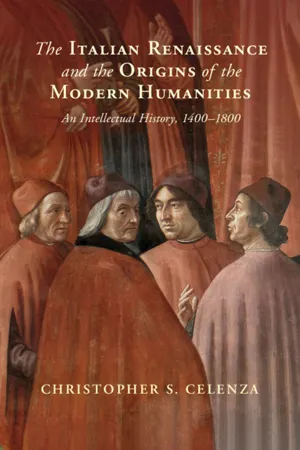
eBook - PDF
The Italian Renaissance and the Origins of the Modern Humanities
An Intellectual History, 1400–1800
- 342 pages
- English
- PDF
- Available on iOS & Android
eBook - PDF
The Italian Renaissance and the Origins of the Modern Humanities
An Intellectual History, 1400–1800
About this book
Christopher Celenza is one of the foremost contemporary scholars of the Renaissance. His ambitious new book focuses on the body of knowledge which we now call the humanities, charting its roots in the Italian Renaissance and exploring its development up to the Enlightenment. Beginning in the fifteenth century, the author shows how thinkers like Lorenzo Valla and Angelo Poliziano developed innovative ways to read texts closely, paying attention to historical context, developing methods to determine a text's authenticity, and taking the humanities seriously as a means of bettering human life. Alongside such novel reading practices, technology – the invention of printing with moveable type – fundamentally changed perceptions of truth. Celenza also reveals how luminaries like Descartes, Diderot, and D'Alembert – as well as many lesser-known scholars – challenged traditional ways of thinking. Celenza's authoritative narrative demonstrates above all how the work of the early modern humanist philosophers had a profound impact on the general quest for human wisdom. His magisterial volume will be essential reading for all those who value the humanities and their fascinating history.
Information
Table of contents
- Cover
- Half-title page
- Title page
- Copyright page
- Dedication
- Contents
- List of Figures
- Preface and Acknowledgments
- 1 Philology, the Italian Renaissance, and Authorship
- 2 Lorenzo Valla, Philology, Emotion
- 3 Losing Your Identity: Angelo Decembrio
- 4 Trust and Authenticity
- 5 Pursuing a Love of Knowledge
- 6 Shaping Knowledge
- 7 Forgetting Philology: René Descartes
- 8 Certainty. Skepticism
- 9 Echoes
- Bibliography
- Index
Trusted by 375,005 students
Access to over 1.5 million titles for a fair monthly price.
Study more efficiently using our study tools.
Frequently asked questions
Yes, you can cancel anytime from the Subscription tab in your account settings on the Perlego website. Your subscription will stay active until the end of your current billing period. Learn how to cancel your subscription
No, books cannot be downloaded as external files, such as PDFs, for use outside of Perlego. However, you can download books within the Perlego app for offline reading on mobile or tablet. Learn how to download books offline
We are an online textbook subscription service, where you can get access to an entire online library for less than the price of a single book per month. With over 1.5 million books across 990+ topics, we’ve got you covered! Learn about our mission
Look out for the read-aloud symbol on your next book to see if you can listen to it. The read-aloud tool reads text aloud for you, highlighting the text as it is being read. You can pause it, speed it up and slow it down. Learn more about Read Aloud
Yes! You can use the Perlego app on both iOS and Android devices to read anytime, anywhere — even offline. Perfect for commutes or when you’re on the go.
Please note we cannot support devices running on iOS 13 and Android 7 or earlier. Learn more about using the app
Please note we cannot support devices running on iOS 13 and Android 7 or earlier. Learn more about using the app
Yes, you can access The Italian Renaissance and the Origins of the Modern Humanities by Christopher S. Celenza in PDF and/or ePUB format, as well as other popular books in History & Asian History. We have over 1.5 million books available in our catalogue for you to explore.