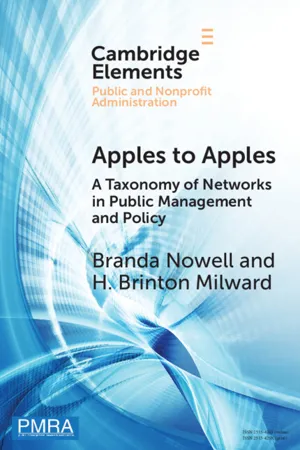
eBook - PDF
Apples to Apples
A Taxonomy of Networks in Public Management and Policy
- 102 pages
- English
- PDF
- Available on iOS & Android
eBook - PDF
Apples to Apples
A Taxonomy of Networks in Public Management and Policy
About this book
Interest in networks in the fields of public management and policy has grown to encompass a wide array of phenomena. However, we lack a stable and empirically verifiable taxonomy for delineating one network class from another. The authors propose all networks and multi-organizational collaborative entities can be sorted into three taxonomic classes: structural-oriented, system-oriented, and purpose-oriented. This Element reviews the intellectual disciplinary histories that have informed our understanding of each of the three classes of networks. It then offers a taxonomic description of each of the three classes of networks. Finally, it provides a field guide for empirically classifying networks. The authors hope is the taxonomy presented will serve as a tool to allow the field to quicken the pace of learning both within and across classes. When we are able to compare apples to apples and avoid inadvertent comparison of apples and oranges, we all get smarter faster.
Information
Table of contents
- Cover
- Title page
- Copyright page
- Apples to Apples: A Taxonomy of Networks in Public Management and Policy
- References
- Acknowledgments
Trusted by 375,005 students
Access to over 1.5 million titles for a fair monthly price.
Study more efficiently using our study tools.
Frequently asked questions
Yes, you can cancel anytime from the Subscription tab in your account settings on the Perlego website. Your subscription will stay active until the end of your current billing period. Learn how to cancel your subscription
No, books cannot be downloaded as external files, such as PDFs, for use outside of Perlego. However, you can download books within the Perlego app for offline reading on mobile or tablet. Learn how to download books offline
We are an online textbook subscription service, where you can get access to an entire online library for less than the price of a single book per month. With over 1.5 million books across 990+ topics, we’ve got you covered! Learn about our mission
Look out for the read-aloud symbol on your next book to see if you can listen to it. The read-aloud tool reads text aloud for you, highlighting the text as it is being read. You can pause it, speed it up and slow it down. Learn more about Read Aloud
Yes! You can use the Perlego app on both iOS and Android devices to read anytime, anywhere — even offline. Perfect for commutes or when you’re on the go.
Please note we cannot support devices running on iOS 13 and Android 7 or earlier. Learn more about using the app
Please note we cannot support devices running on iOS 13 and Android 7 or earlier. Learn more about using the app
Yes, you can access Apples to Apples by Branda Nowell,H. Brinton Milward in PDF and/or ePUB format, as well as other popular books in Business & Organisational Behaviour. We have over 1.5 million books available in our catalogue for you to explore.