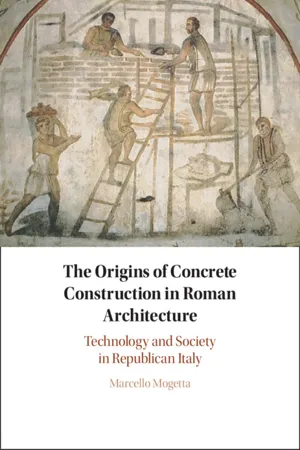
eBook - PDF
The Origins of Concrete Construction in Roman Architecture
Technology and Society in Republican Italy
- 336 pages
- English
- PDF
- Available on iOS & Android
eBook - PDF
The Origins of Concrete Construction in Roman Architecture
Technology and Society in Republican Italy
About this book
In this study, Marcello Mogetta examines the origins and early dissemination of concrete technology in Roman Republican architecture. Framing the genesis of innovative building processes and techniques within the context of Rome's early expansion, he traces technological change in monumental construction in long-established urban centers and new Roman colonial cites founded in the 2nd century BCE in central Italy. Mogetta weaves together excavation data from both public monuments and private domestic architecture that have been previously studied in isolation. Highlighting the organization of the building industry, he also explores the political motivations and cultural aspirations of patrons of monumental architecture, reconstructing how they negotiated economic and logistical constraints by drawing from both local traditions and long-distance networks. By incorporating the available evidence into the development of concrete technology, Mogetta also demonstrates the contributions of anonymous builders and contractors, shining a light on their ability to exploit locally available resources.
Information
Table of contents
- Cover
- Half-title page
- Title page
- Copyright page
- Contents
- List of Plates
- List of Figures
- List of Tables
- Acknowledgments
- One Introduction
- Two Deconstructing Roman Concrete
- Three A New Date for Concrete in Rome
- Four A View from the Suburbium
- Five Building Samnite Pompeii
- Six Colonial Networks
- Seven Conclusion
- Appendix Catalog of Sites
- Glossary
- Bibliography and Abbreviations
- Index
Trusted by 375,005 students
Access to over 1.5 million titles for a fair monthly price.
Study more efficiently using our study tools.
Frequently asked questions
Yes, you can cancel anytime from the Subscription tab in your account settings on the Perlego website. Your subscription will stay active until the end of your current billing period. Learn how to cancel your subscription
No, books cannot be downloaded as external files, such as PDFs, for use outside of Perlego. However, you can download books within the Perlego app for offline reading on mobile or tablet. Learn how to download books offline
We are an online textbook subscription service, where you can get access to an entire online library for less than the price of a single book per month. With over 1.5 million books across 990+ topics, we’ve got you covered! Learn about our mission
Look out for the read-aloud symbol on your next book to see if you can listen to it. The read-aloud tool reads text aloud for you, highlighting the text as it is being read. You can pause it, speed it up and slow it down. Learn more about Read Aloud
Yes! You can use the Perlego app on both iOS and Android devices to read anytime, anywhere — even offline. Perfect for commutes or when you’re on the go.
Please note we cannot support devices running on iOS 13 and Android 7 or earlier. Learn more about using the app
Please note we cannot support devices running on iOS 13 and Android 7 or earlier. Learn more about using the app
Yes, you can access The Origins of Concrete Construction in Roman Architecture by Marcello Mogetta in PDF and/or ePUB format, as well as other popular books in Social Sciences & Archaeology. We have over 1.5 million books available in our catalogue for you to explore.