- 346 pages
- English
- PDF
- Available on iOS & Android
eBook - PDF
About this book
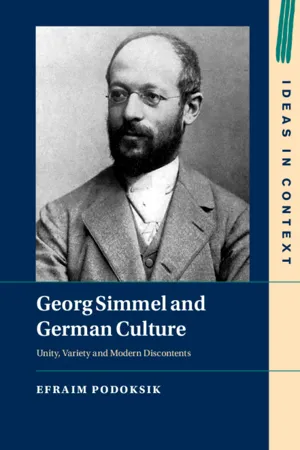
The significance of the German philosopher and social thinker, Georg Simmel (1858–1918), is only now being recognised by intellectual historians. Through penetrating readings of Simmel's thought, taken as a series of reflections on the essence of modernity and modern civilisation, Efraim Podoksik places his ideas within the context of intellectual life in Germany, and especially Berlin, under the Kaiserreich. Modernity, characterised by the growing differentiation and fragmentation of culture and society, was a fundamental issue during Simmel's life, underpinning central intellectual debates in Imperial Germany. Simmel's thought is depicted here as an attempt at transforming the complexity of these debates into a coherent worldview that can serve as an effective guide to understanding their main parameters. Paying particular attention to the genealogy and usage of the concepts of Bildung, culture and civilisation in Germany, this study offers contextual analyses of Simmel's philosophies of culture, society, art, religion and the feminine, as well as his interpretations of Dante, Kant, Nietzsche, Schopenhauer, Goethe and Rembrandt.
Information
Table of contents
- Cover
- Half-title page
- Series page
- Title page
- Copyright page
- Contents
- Acknowledgements
- Note on Translations and References
- Introduction
- Chapter 1 Bildung, Kultur, Crisis
- Chapter 2 Unity in Variety
- Chapter 3 Unity versus Variety
- Chapter 4 Unity above Variety
- Conclusion
- Bibliography
- Index
Trusted by 375,005 students
Access to over 1.5 million titles for a fair monthly price.
Study more efficiently using our study tools.
Frequently asked questions
Yes, you can cancel anytime from the Subscription tab in your account settings on the Perlego website. Your subscription will stay active until the end of your current billing period. Learn how to cancel your subscription
No, books cannot be downloaded as external files, such as PDFs, for use outside of Perlego. However, you can download books within the Perlego app for offline reading on mobile or tablet. Learn how to download books offline
We are an online textbook subscription service, where you can get access to an entire online library for less than the price of a single book per month. With over 1.5 million books across 990+ topics, we’ve got you covered! Learn about our mission
Look out for the read-aloud symbol on your next book to see if you can listen to it. The read-aloud tool reads text aloud for you, highlighting the text as it is being read. You can pause it, speed it up and slow it down. Learn more about Read Aloud
Yes! You can use the Perlego app on both iOS and Android devices to read anytime, anywhere — even offline. Perfect for commutes or when you’re on the go.
Please note we cannot support devices running on iOS 13 and Android 7 or earlier. Learn more about using the app
Please note we cannot support devices running on iOS 13 and Android 7 or earlier. Learn more about using the app
Yes, you can access Georg Simmel and German Culture by Efraim Podoksik in PDF and/or ePUB format, as well as other popular books in Politics & International Relations & Political History & Theory. We have over 1.5 million books available in our catalogue for you to explore.