eBook - PDF
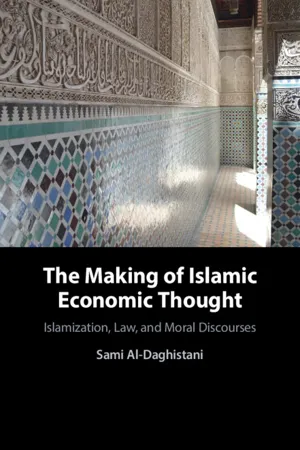
The Making of Islamic Economic Thought
Islamization, Law, and Moral Discourses
- 338 pages
- English
- PDF
- Available on iOS & Android
eBook - PDF
About this book
Interrogating the development and conceptual framework of economic thought in the Islamic tradition pertaining to ethical, philosophical, and theological ideas, this book provides a critique of modern Islamic economics as a hybrid economic system. From the outset, Sami Al-Daghistani is concerned with the polyvalent methodology of studying the phenomenon of Islamic economic thought as a human science in that it nurtures a complex plentitude of meanings and interpretations associated with the moral self. By studying legal scholars, theologians, and Sufis in the classical period, Al-Daghistani looks at economic thought in the context of Shar?'a's moral law. Alongside critiquing modern developments of Islamic economics, he puts forward an idea for a plural epistemology of Islam's moral economy, which advocates for a multifaceted hermeneutical reading of the subject in light of a moral law, embedded in a particular cosmology of human relationality, metaphysical intelligibility, and economic subjectivity.
Information
Table of contents
- Cover
- Half-title page
- Title page
- Copyright page
- Contents
- List of Figures
- Acknowledgments
- Introduction
- 1 The Force of Revivalism and Islamization: Their Impact on Knowledge, Politics, and Islamic Economics
- 2 The Present: Muslim Economists and the Constellation of Islamic Economics
- 3 The Past Perfect: Sharīʿa and the Intellectual History of Islamic Economic Teachings
- 4 The Appraisal: Contemporary Islamic Economics and the Entrenchment of Modernity
- 5 Pluralistic Epistemology of Islam’s Moral Economics
- Conclusion: Moral over Legal, Pluralistic over Monolithic
- Appendix
- Bibliography
- Index
Trusted by 375,005 students
Access to over 1.5 million titles for a fair monthly price.
Study more efficiently using our study tools.
Frequently asked questions
Yes, you can cancel anytime from the Subscription tab in your account settings on the Perlego website. Your subscription will stay active until the end of your current billing period. Learn how to cancel your subscription
No, books cannot be downloaded as external files, such as PDFs, for use outside of Perlego. However, you can download books within the Perlego app for offline reading on mobile or tablet. Learn how to download books offline
We are an online textbook subscription service, where you can get access to an entire online library for less than the price of a single book per month. With over 1.5 million books across 990+ topics, we’ve got you covered! Learn about our mission
Look out for the read-aloud symbol on your next book to see if you can listen to it. The read-aloud tool reads text aloud for you, highlighting the text as it is being read. You can pause it, speed it up and slow it down. Learn more about Read Aloud
Yes! You can use the Perlego app on both iOS and Android devices to read anytime, anywhere — even offline. Perfect for commutes or when you’re on the go.
Please note we cannot support devices running on iOS 13 and Android 7 or earlier. Learn more about using the app
Please note we cannot support devices running on iOS 13 and Android 7 or earlier. Learn more about using the app
Yes, you can access The Making of Islamic Economic Thought by Sami Al-Daghistani in PDF and/or ePUB format, as well as other popular books in Economics & Economic Theory. We have over 1.5 million books available in our catalogue for you to explore.