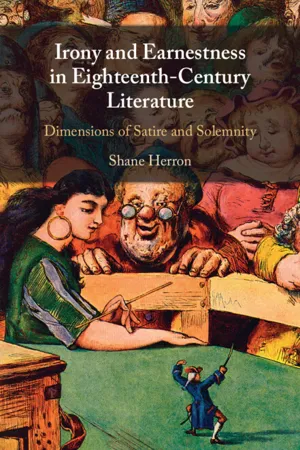
eBook - PDF
Irony and Earnestness in Eighteenth-Century Literature
Dimensions of Satire and Solemnity
- 250 pages
- English
- PDF
- Available on iOS & Android
eBook - PDF
Irony and Earnestness in Eighteenth-Century Literature
Dimensions of Satire and Solemnity
About this book
The conventional literary history of the eighteenth century holds that upstart novelists and other intensely serious writers worked against the conservative and ironic sensibility of an earlier generation of satirists. However, many of these ostensibly earnest writers were exceptional satirists in their own right, employing the same ruses, tricks, and deceptions throughout their work. The novels of such canonical figures as Behn and Defoe, for example, passed themselves off as real documents, just as an earlier generation of hack writers combined the serious and the absurd. Re-examining this nexus between the ludicrous and the solemn, Shane Herron argues that intense earnestness was itself a central component of the ironic sensibility of the great age of literary satire and of Swift's work in particular. The sensationalism and confessionalism of earnestness were frequently employed tendentiously, while ironic and satirical literature often incorporated genuine moments of earnestness to advance writerly aims.
Information
Table of contents
- Cover
- Half-title page
- Title page
- Copyright page
- Dedication
- Contents
- Acknowledgments
- List of Abbreviations
- Introduction On Ludicrous Solemnity
- Chapter 1 Swift and the Hacks: A Relationship Reconsidered
- Chapter 2 “By One of the Fair Sex”: Irony, Sovereignty, and Sexual Difference
- Chapter 3 Keeping Up Appearances: Satire Between Preservation and Reformation
- Chapter 4 Dark Humor and Moral Sense Theory: Or, How Swift Learned to Stop Worrying and Love Evil
- Chapter 5 Gratitude for the Ordinary: Defoe’s Irony
- Epilogue: Earnest Satire, Cynical Credulity, and the Task of Irony
- Notes
- Bibliography
- Index
Trusted by 375,005 students
Access to over 1.5 million titles for a fair monthly price.
Study more efficiently using our study tools.
Frequently asked questions
Yes, you can cancel anytime from the Subscription tab in your account settings on the Perlego website. Your subscription will stay active until the end of your current billing period. Learn how to cancel your subscription
No, books cannot be downloaded as external files, such as PDFs, for use outside of Perlego. However, you can download books within the Perlego app for offline reading on mobile or tablet. Learn how to download books offline
We are an online textbook subscription service, where you can get access to an entire online library for less than the price of a single book per month. With over 1.5 million books across 990+ topics, we’ve got you covered! Learn about our mission
Look out for the read-aloud symbol on your next book to see if you can listen to it. The read-aloud tool reads text aloud for you, highlighting the text as it is being read. You can pause it, speed it up and slow it down. Learn more about Read Aloud
Yes! You can use the Perlego app on both iOS and Android devices to read anytime, anywhere — even offline. Perfect for commutes or when you’re on the go.
Please note we cannot support devices running on iOS 13 and Android 7 or earlier. Learn more about using the app
Please note we cannot support devices running on iOS 13 and Android 7 or earlier. Learn more about using the app
Yes, you can access Irony and Earnestness in Eighteenth-Century Literature by Shane Herron in PDF and/or ePUB format, as well as other popular books in Literature & English Literary Criticism. We have over 1.5 million books available in our catalogue for you to explore.