- 110 pages
- English
- PDF
- Available on iOS & Android
eBook - PDF
About this book
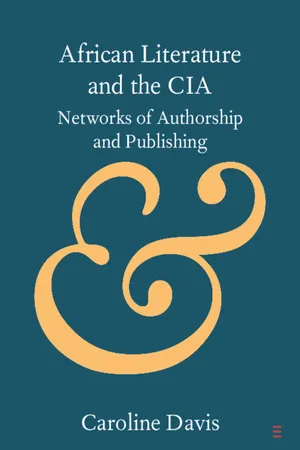
During the period of decolonisation in Africa, the CIA covertly subsidised a number of African authors, editors and publishers as part of its anti-communist propaganda strategy. Managed by two front organisations, the Congress of Cultural Freedom and the Farfield Foundation, its Africa programme stretched across the continent. This Element unravels the hidden networks and associations underpinning African literary publishing in the 1960s; it evaluates the success of the CIA in secretly infiltrating and influencing African literary magazines and publishing firms, and examines the extent to which new circuits of cultural and literary power emerged. Based on new archival evidence relating to the Transcription Centre, The Classic and The New African, it includes case studies of Wole Soyinka, Nat Nakasa and Bessie Head, which assess how the authors' careers were affected by these transnational networks and also reveal how they challenged, subverted, and resisted external influence and control.
Information
Table of contents
- Cover
- Title page
- Copyright page
- African Literature and the CIA: Networks of Authorship and Publishing
- Bibliography
- Acknowledgments
Trusted by 375,005 students
Access to over 1.5 million titles for a fair monthly price.
Study more efficiently using our study tools.
Frequently asked questions
Yes, you can cancel anytime from the Subscription tab in your account settings on the Perlego website. Your subscription will stay active until the end of your current billing period. Learn how to cancel your subscription
No, books cannot be downloaded as external files, such as PDFs, for use outside of Perlego. However, you can download books within the Perlego app for offline reading on mobile or tablet. Learn how to download books offline
We are an online textbook subscription service, where you can get access to an entire online library for less than the price of a single book per month. With over 1.5 million books across 990+ topics, we’ve got you covered! Learn about our mission
Look out for the read-aloud symbol on your next book to see if you can listen to it. The read-aloud tool reads text aloud for you, highlighting the text as it is being read. You can pause it, speed it up and slow it down. Learn more about Read Aloud
Yes! You can use the Perlego app on both iOS and Android devices to read anytime, anywhere — even offline. Perfect for commutes or when you’re on the go.
Please note we cannot support devices running on iOS 13 and Android 7 or earlier. Learn more about using the app
Please note we cannot support devices running on iOS 13 and Android 7 or earlier. Learn more about using the app
Yes, you can access African Literature and the CIA by Caroline Davis in PDF and/or ePUB format, as well as other popular books in Languages & Linguistics & Publishing. We have over 1.5 million books available in our catalogue for you to explore.