In A Guide to Post-classical Narration, Eleftheria Thanouli expands and substantially develops the innovative theoretical work of her previous publication, Post-classical Cinema: an International Poetics of Film Narration (2009).
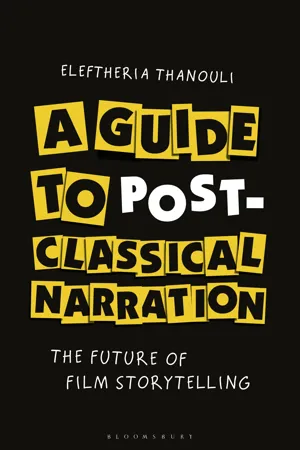
A Guide to Post-classical Narration: The Future of Film Storytelling presents a concise and comprehensive overview of the creative norms of the post-classical mode of narration. With dozens of cases studies and hundreds of color stills from films across the globe, this book provides the definitive account of post-classical storytelling and its techniques. After surfacing in auteur films in varied production milieus in the 1990s, the post-classical options continued to gain ground throughout the 2000s and 2010s, gradually fertilizing several mainstream productions in Hollywood. From Lars von Trier's Europa (1991) to Zack Snyder's Army of the Dead (2021) and Baz Luhrmann's Elvis (2022), the post-classical narration has shown not only impressive resilience but also tremendous creativity in transforming its key formal principles, such as fragmented and multi-thread plotlines, hypermediated realism, parody, graphic frame construction, complex chronology, and intense self-consciousness.
Through the meticulous textual analysis of the post-classical works, Eleftheria Thanouli addresses head-on a series of methodological questions in narrative research and brings the tradition of historical poetics back into the limelight. By reinforcing her previous work with numerous new films as well as more nuanced narrative terms and concepts, she not only strengthens her position on post-classical cinema but also establishes the relevance of formalist analysis in the study of film today.
- 288 pages
- English
- ePUB (mobile friendly)
- Available on iOS & Android
eBook - ePub
About this book
Information
Table of contents
- Cover
- Half-title Page
- Dedication
- Title Page
- Contents
- Acknowledgments
- Preface
- Introduction
- 1 Post-classical Narrative Logic
- 2 Post-classical Space
- 3 Post-classical Time
- 4 Post-classical Narration
- 5 The Post-classical Auteur: Quentin Tarantino
- 6 Conclusion: On Modes and Boundaries
- Appendix A: A List of Suggested Post-classical Films
- References
- Filmography
- Index
- Copyright
Trusted by 375,005 students
Access to over 1.5 million titles for a fair monthly price.
Study more efficiently using our study tools.
Frequently asked questions
Yes, you can cancel anytime from the Subscription tab in your account settings on the Perlego website. Your subscription will stay active until the end of your current billing period. Learn how to cancel your subscription
No, books cannot be downloaded as external files, such as PDFs, for use outside of Perlego. However, you can download books within the Perlego app for offline reading on mobile or tablet. Learn how to download books offline
Perlego offers two plans: Essential and Complete
- Essential is ideal for learners and professionals who enjoy exploring a wide range of subjects. Access the Essential Library with 800,000+ trusted titles and best-sellers across business, personal growth, and the humanities. Includes unlimited reading time and Standard Read Aloud voice.
- Complete: Perfect for advanced learners and researchers needing full, unrestricted access. Unlock 1.5M+ books across hundreds of subjects, including academic and specialized titles. The Complete Plan also includes advanced features like Premium Read Aloud and Research Assistant.
We are an online textbook subscription service, where you can get access to an entire online library for less than the price of a single book per month. With over 1.5 million books across 990+ topics, we’ve got you covered! Learn about our mission
Look out for the read-aloud symbol on your next book to see if you can listen to it. The read-aloud tool reads text aloud for you, highlighting the text as it is being read. You can pause it, speed it up and slow it down. Learn more about Read Aloud
Yes! You can use the Perlego app on both iOS and Android devices to read anytime, anywhere — even offline. Perfect for commutes or when you’re on the go.
Please note we cannot support devices running on iOS 13 and Android 7 or earlier. Learn more about using the app
Please note we cannot support devices running on iOS 13 and Android 7 or earlier. Learn more about using the app
Yes, you can access A Guide to Post-classical Narration by Eleftheria Thanouli in PDF and/or ePUB format, as well as other popular books in Media & Performing Arts & Film History & Criticism. We have over 1.5 million books available in our catalogue for you to explore.