Provides unique insight into Reconstruction's downfall and Jim Crow's emergence.
In the years and decades following the American Civil War, veteran abolitionists actively thought and wrote about the campaign to end enslavement immediately. This study explores the late-in-life reflections of several antislavery memorial and historical writers, evaluating the stable and shifting meanings of antebellum abolitionism amidst dramatic changes in postbellum race relations. By investigating veteran abolitionists as movement chroniclers and commemorators and situating their texts within various contexts, Raymond James Krohn further assesses the humanitarian commitments of activists who had valued themselves as the enslaved people's steadfast friends.
Never solely against slavery, post-1830 abolitionism challenged widely held anti-Black prejudices as well. Dedicated to emancipating the enslaved and elevating people of color, it equipped adherents with the necessary linguistic resources to wage a valiant, sustained philanthropic fight. Abolitionist Twilights focuses on how the status and condition of the freedpeople and their descendants affected book-length representations of antislavery persons and events. In probing veteran– abolitionist engagement in or disengagement from an ongoing African American freedom struggle, this ambitious volume ultimately problematizes scholarly understandings of abolitionism's racial justice history and legacy.
eBook - ePub
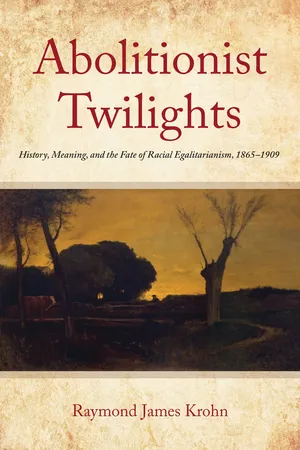
Abolitionist Twilights
History, Meaning, and the Fate of Racial Egalitarianism, 1865-1909
- 288 pages
- English
- ePUB (mobile friendly)
- Available on iOS & Android
eBook - ePub
Abolitionist Twilights
History, Meaning, and the Fate of Racial Egalitarianism, 1865-1909
About this book
Information
Publisher
Fordham University PressYear
2023Print ISBN
9781531505608
9781531505592
Edition
1eBook ISBN
9781531505615
Table of contents
- Cover
- Title Page
- Copyright
- Dedication
- Contents
- Introduction: What Is Abolitionism Now? From the Disposition of the AASS to the Determinants of Abolitionist History
- 1. Antislavery Moderated: Samuel Joseph May and the Lessons of Respectable Reform
- 2. Antislavery Elevated: William Wells Brown and the Purpose of Black Activism
- 3. Antislavery Vindicated: Oliver Johnson and the Value of Abolitionism’s Grand Old Party
- 4. Antislavery Sanctified: Parker Pillsbury and the Spirit of Abolitionism in the Fields
- 5. A Tale of Two Slaveries: Aaron Macy Powell and the Transfiguration of Abolitionism
- 6. Songs of Innocence and Experience: Thomas Wentworth Higginson and the Abdication of Abolitionism
- 7. What Was Antislavery For? From the Disbandment of the AASS to the Determination of Abolitionist Women
- Coda: Complicated Legacies
- Acknowledgments
- Notes
- Index
- About the Author
Trusted by 375,005 students
Access to over 1.5 million titles for a fair monthly price.
Study more efficiently using our study tools.
Frequently asked questions
Yes, you can cancel anytime from the Subscription tab in your account settings on the Perlego website. Your subscription will stay active until the end of your current billing period. Learn how to cancel your subscription
No, books cannot be downloaded as external files, such as PDFs, for use outside of Perlego. However, you can download books within the Perlego app for offline reading on mobile or tablet. Learn how to download books offline
Perlego offers two plans: Essential and Complete
- Essential is ideal for learners and professionals who enjoy exploring a wide range of subjects. Access the Essential Library with 800,000+ trusted titles and best-sellers across business, personal growth, and the humanities. Includes unlimited reading time and Standard Read Aloud voice.
- Complete: Perfect for advanced learners and researchers needing full, unrestricted access. Unlock 1.5M+ books across hundreds of subjects, including academic and specialized titles. The Complete Plan also includes advanced features like Premium Read Aloud and Research Assistant.
We are an online textbook subscription service, where you can get access to an entire online library for less than the price of a single book per month. With over 1.5 million books across 990+ topics, we’ve got you covered! Learn about our mission
Look out for the read-aloud symbol on your next book to see if you can listen to it. The read-aloud tool reads text aloud for you, highlighting the text as it is being read. You can pause it, speed it up and slow it down. Learn more about Read Aloud
Yes! You can use the Perlego app on both iOS and Android devices to read anytime, anywhere — even offline. Perfect for commutes or when you’re on the go.
Please note we cannot support devices running on iOS 13 and Android 7 or earlier. Learn more about using the app
Please note we cannot support devices running on iOS 13 and Android 7 or earlier. Learn more about using the app
Yes, you can access Abolitionist Twilights by Raymond James Krohn in PDF and/or ePUB format, as well as other popular books in History & Social Science Biographies. We have over 1.5 million books available in our catalogue for you to explore.