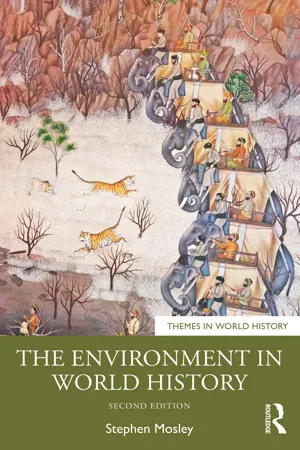
The Environment in World History
eBook - ePub

The Environment in World History

  1. 120 pages
  2. English
  3. ePUB (mobile friendly)
  4. Available on iOS & Android
eBook - ePub

The Environment in World History

About this book

Now in its second edition and refreshed by a decade of new research, The Environment in World History uncovers the deep-rooted causes of interconnected climate, biodiversity, and ecological crises that have brought the environment to the top of the global political agenda in the twenty-first century.

Its expanded chapters and case studies explore a wide range of issues including the following: the hunting of wildlife and the loss of biodiversity across the globe; deforestation and the development of strategies to protect the world's forests; soil degradation caused by worldwide agricultural expansion, one of the most profound ways that humans have altered the planet; the widening impact of urban-industrial growth and the deepening ecological footprints of the world's cities; and the rising levels of air, land and water pollution as the trade-off for continued economic growth worldwide. Covering the last five hundred years, it offers an essential environmental perspective on well-known world history narratives of imperialism and colonialism, trade and commerce, technological progress and the advance of civilisation.

Clearly written and fully up-to-date, it is an invaluable resource for all students of world history and environmental studies.

Frequently asked questions

Yes, you can cancel anytime from the Subscription tab in your account settings on the Perlego website. Your subscription will stay active until the end of your current billing period. Learn how to cancel your subscription.
No, books cannot be downloaded as external files, such as PDFs, for use outside of Perlego. However, you can download books within the Perlego app for offline reading on mobile or tablet. Learn more here.
Perlego offers two plans: Essential and Complete
  • Essential is ideal for learners and professionals who enjoy exploring a wide range of subjects. Access the Essential Library with 800,000+ trusted titles and best-sellers across business, personal growth, and the humanities. Includes unlimited reading time and Standard Read Aloud voice.
  • Complete: Perfect for advanced learners and researchers needing full, unrestricted access. Unlock 1.4M+ books across hundreds of subjects, including academic and specialized titles. The Complete Plan also includes advanced features like Premium Read Aloud and Research Assistant.
Both plans are available with monthly, semester, or annual billing cycles.
We are an online textbook subscription service, where you can get access to an entire online library for less than the price of a single book per month. With over 1 million books across 1000+ topics, we’ve got you covered! Learn more here.
Look out for the read-aloud symbol on your next book to see if you can listen to it. The read-aloud tool reads text aloud for you, highlighting the text as it is being read. You can pause it, speed it up and slow it down. Learn more here.
Yes! You can use the Perlego app on both iOS or Android devices to read anytime, anywhere — even offline. Perfect for commutes or when you’re on the go.
Please note we cannot support devices running on iOS 13 and Android 7 or earlier. Learn more about using the app.
Yes, you can access The Environment in World History by Stephen Mosley in PDF and/or ePUB format, as well as other popular books in History & World History. We have over one million books available in our catalogue for you to explore.

Information

Publisher
Routledge
Year
2023
Print ISBN
9781138301580
eBook ISBN
9781000991444
Edition
2
Topic
History
Index
History

Table of contents

  1. Cover
  2. Half Title
  3. Series Page
  4. Title Page
  5. Copyright Page
  6. Table of Contents
  7. List of tables
  8. Acknowledgements
  9. 1 Introduction: Environment and history
  10. 2 The world hunt
  11. 3 Forests and forestry
  12. 4 Soils and irrigation
  13. 5 Cities and the environment
  14. 6 Conclusion: Beyond the limits?
  15. Index