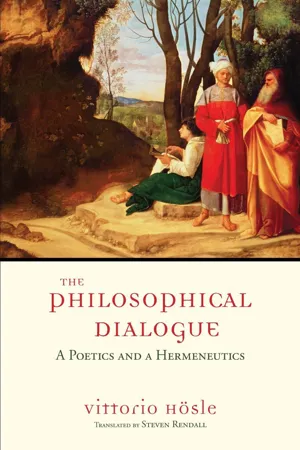
The Philosophical Dialogue
eBook - PDF

The Philosophical Dialogue

A Poetics and a Hermeneutics

  1. English
  2. PDF
  3. Available on iOS & Android
eBook - PDF

The Philosophical Dialogue

A Poetics and a Hermeneutics

About this book

No overall history of the philosophical dialogue has appeared since Rudolf Hirzel's two-volume study was published in 1895. In The Philosophical Dialogue: A Poetics and a Hermeneutics, Vittorio Hösle covers the development of the genre from its beginning with Plato to the late twentieth-century work of Iris Murdoch and Paul Feyerabend. Hösle presents a taxonomy and a doctrine of categories for the complex literary genre of the philosophical dialogue, focusing on the poetical laws that structure the genre, and develops hermeneutical rules for its correct interpretation.

Following an introduction that employs the categories of subjectivity and intersubjectivity to classify philosophy's modes of expression, Hösle's book is structured by the classical triad of the production, inner structure, and reception of the literary dialogue. To explain what is meant by "philosophical dialogue," Hösle first deals with the specific traits of philosophical dialogue in contrast to other literary forms of philosophy and its special status among them. Second, he distinguishes the philosophical dialogue as a literary genre from actual philosophical conversation, and as a philosophical literary genre from nonphilosophical literary dialogues. Finally, he takes up the connection between literary form and philosophical content in the philosophical dialogue. Numerous authors of dialogues are discussed, with a special focus on Plato, Cicero, Augustine, Hume, and Diderot.

Originally published in Germany as Der philosophische Dialog: Eine Poetik und Hermeneutik (2006), this book not only contributes to the philosophical discussion of dialogue but to a great extent defines it. This fine translation will prove useful to both philosophers and literary critics in the English-speaking world.

Frequently asked questions

Yes, you can cancel anytime from the Subscription tab in your account settings on the Perlego website. Your subscription will stay active until the end of your current billing period. Learn how to cancel your subscription.
No, books cannot be downloaded as external files, such as PDFs, for use outside of Perlego. However, you can download books within the Perlego app for offline reading on mobile or tablet. Learn more here.
Perlego offers two plans: Essential and Complete
  • Essential is ideal for learners and professionals who enjoy exploring a wide range of subjects. Access the Essential Library with 800,000+ trusted titles and best-sellers across business, personal growth, and the humanities. Includes unlimited reading time and Standard Read Aloud voice.
  • Complete: Perfect for advanced learners and researchers needing full, unrestricted access. Unlock 1.4M+ books across hundreds of subjects, including academic and specialized titles. The Complete Plan also includes advanced features like Premium Read Aloud and Research Assistant.
Both plans are available with monthly, semester, or annual billing cycles.
We are an online textbook subscription service, where you can get access to an entire online library for less than the price of a single book per month. With over 1 million books across 1000+ topics, we’ve got you covered! Learn more here.
Look out for the read-aloud symbol on your next book to see if you can listen to it. The read-aloud tool reads text aloud for you, highlighting the text as it is being read. You can pause it, speed it up and slow it down. Learn more here.
Yes! You can use the Perlego app on both iOS or Android devices to read anytime, anywhere — even offline. Perfect for commutes or when you’re on the go.
Please note we cannot support devices running on iOS 13 and Android 7 or earlier. Learn more about using the app.
Yes, you can access The Philosophical Dialogue by Vittorio Hösle, Steven Rendall in PDF and/or ePUB format, as well as other popular books in Philosophy & Theatre History & Criticism. We have over one million books available in our catalogue for you to explore.

Table of contents

  1. Cover
  2. Half title
  3. Title page
  4. Copyright
  5. Dedication
  6. Contents
  7. Abbreviations
  8. Preface
  9. Introduction
  10. 1. The Place of Philosophical Dialogue among the Literary Forms of Philosophy
  11. 2. Conversation and Dialogue
  12. 3. On the Relationship between Form and Content in the Philosophical Dialogue
  13. Part I: The Production of Philosophical Dialogue
  14. Part II: The Universe of the Philosophical Dialogue
  15. Part III: The Reception of the Philosophical Dialogue
  16. Bibliography
  17. Index