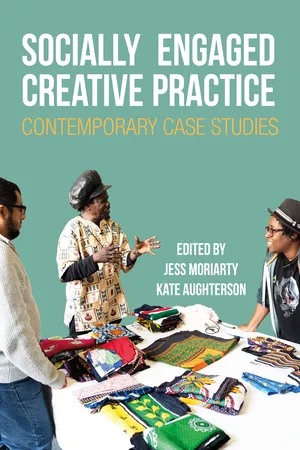
Socially Engaged Creative Practice
Contemporary Case Studies
- English
- ePUB (mobile friendly)
- Available on iOS & Android
About this book
This is the second book in the Performance and Communities series. An edited collection from academics and artists engages with both these notions of performance â that of identities in and through time and space - and of more formal instances of specific time-limited performances; textual, embodied, visual and communal.
Each chapter focuses on an individual or group's mode of working and methodological practice of performance across a range of modes, disciplines and media â from community opera to online queer performance, from anti-racist class-room pedagogy to 1980s cabaret in nightclubs, from community art projects in schools to community writing projects in transport interchanges, the performers, writers and creators represented here all engage and grapple with contemporary performance as a situated practice and as a problematic.
The personal perspective of each performer â directors, librettists, producers, writers, performers â is explicitly located in a community and the book offers a series of case studies detailing socially engaged work that aligns with concepts of performance and community.
Frequently asked questions
- Essential is ideal for learners and professionals who enjoy exploring a wide range of subjects. Access the Essential Library with 800,000+ trusted titles and best-sellers across business, personal growth, and the humanities. Includes unlimited reading time and Standard Read Aloud voice.
- Complete: Perfect for advanced learners and researchers needing full, unrestricted access. Unlock 1.4M+ books across hundreds of subjects, including academic and specialized titles. The Complete Plan also includes advanced features like Premium Read Aloud and Research Assistant.
Please note we cannot support devices running on iOS 13 and Android 7 or earlier. Learn more about using the app.
Information
Table of contents
- Cover
- Title
- Copyright
- Contents
- List of Figures
- Introduction
- SECTION ONE: CHANGING THEATRES
- SECTION TWO: TAKING TO THE STREETS
- SECTION THREE: TRANSFORMING SPACES AND STORIES
- SECTION FOUR: OPENING UP INSTITUTIONS
- Notes on Contributors