A thorough investigation of the current combination of austerity and extravagance that characterizes government spending and central bank monetary policy
At the close of the 1970s, government treasuries and central banks took a vow of perpetual self-restraint. To this day, fiscal authorities fret over soaring public debt burdens, while central bankers wring their hands at the slightest sign of rising wages. As the brief reprieve of coronavirus spending made clear, no departure from government austerity will be tolerated without a corresponding act of penance.
Yet we misunderstand the scope of neoliberal public finance if we assume austerity to be its sole setting. Beyond the zero-sum game of direct claims on state budgets lies a realm of indirect government spending that escapes the naked eye. Capital gains are multiply subsidized by a tax system that reserves its greatest rewards for financial asset holders. And for all its airs of haughty asceticism, the Federal Reserve has become adept at facilitating the inflation of asset values while ruthlessly suppressing wages. Neoliberalism is as extravagant as it is austere, and this paradox needs to be grasped if we are to challenge its core modus operandi.
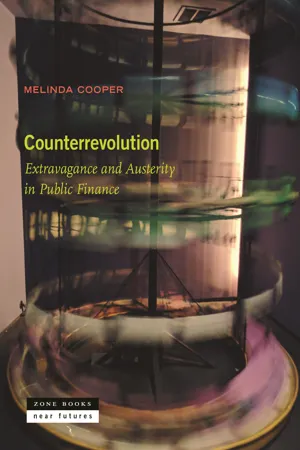
Melinda Cooper examines the major schools of thought that have shaped neoliberal common sense around public finance. Focusing, in particular, on Virginia school public choice theory and supply-side economics, she shows how these currents produced distinct but ultimately complementary responses to the capitalist crisis of the 1970s. With its intellectual roots in the conservative Southern Democratic tradition, Virginia school public choice theory espoused an austere doctrine of budget balance. The supply-side movement, by contrast, advocated tax cuts without spending restraint and debt issuance without guilt, in an apparent repudiation of austerity. Yet, for all their differences, the two schools converged around the need to rein in the redistributive uses of public spending. Together, they drove a counterrevolution in public finance that deepened the divide between rich and poor and revived the fortunes of dynastic wealth.
Far-reaching as the neoliberal counterrevolution has been, Cooper still identifies a counterfactual history of unrealized possibilities in the capitalist crisis of the 1970s. She concludes by inviting us to rethink the concept of revolution and raises the question: Is another politics of extravagance possible?
- English
- ePUB (mobile friendly)
- Available on iOS & Android
eBook - ePub
About this book
Information
Table of contents
- Cover
- Title Page
- Copyright
- Contents
- Introduction: Fiscal and Monetary Counterrevolution
- I. Capital Gains: Supply-Side Economics and the Return of Dynastic Capitalism
- II. Wage Losses: Supply-Side Populism and the Blue-Collar Producer
- III. Infinite Regress: Virginia School Neoliberalism and the Tax Revolt
- IV. Constitutional Austerity: Virginia School Neoliberalism and the Balanced Budget Amendment
- V. Aborting America: The Reproductive Politics of the National Debt
- Conclusion: On Fiscal and Monetary Revolution
- Acknowledgments
- Notes
- Index
Trusted by 375,005 students
Access to over 1.5 million titles for a fair monthly price.
Study more efficiently using our study tools.
Frequently asked questions
Yes, you can cancel anytime from the Subscription tab in your account settings on the Perlego website. Your subscription will stay active until the end of your current billing period. Learn how to cancel your subscription
No, books cannot be downloaded as external files, such as PDFs, for use outside of Perlego. However, you can download books within the Perlego app for offline reading on mobile or tablet. Learn how to download books offline
Perlego offers two plans: Essential and Complete
- Essential is ideal for learners and professionals who enjoy exploring a wide range of subjects. Access the Essential Library with 800,000+ trusted titles and best-sellers across business, personal growth, and the humanities. Includes unlimited reading time and Standard Read Aloud voice.
- Complete: Perfect for advanced learners and researchers needing full, unrestricted access. Unlock 1.5M+ books across hundreds of subjects, including academic and specialized titles. The Complete Plan also includes advanced features like Premium Read Aloud and Research Assistant.
We are an online textbook subscription service, where you can get access to an entire online library for less than the price of a single book per month. With over 1.5 million books across 990+ topics, we’ve got you covered! Learn about our mission
Look out for the read-aloud symbol on your next book to see if you can listen to it. The read-aloud tool reads text aloud for you, highlighting the text as it is being read. You can pause it, speed it up and slow it down. Learn more about Read Aloud
Yes! You can use the Perlego app on both iOS and Android devices to read anytime, anywhere — even offline. Perfect for commutes or when you’re on the go.
Please note we cannot support devices running on iOS 13 and Android 7 or earlier. Learn more about using the app
Please note we cannot support devices running on iOS 13 and Android 7 or earlier. Learn more about using the app
Yes, you can access Counterrevolution by Melinda Cooper in PDF and/or ePUB format, as well as other popular books in Política y relaciones internacionales & Teoría económica. We have over 1.5 million books available in our catalogue for you to explore.