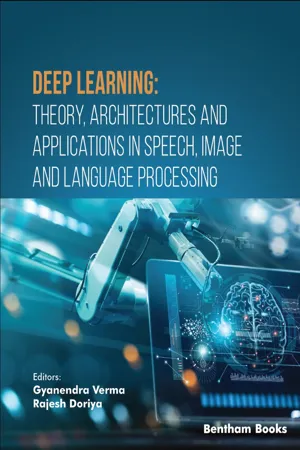
This book is a detailed reference guide on deep learning and its applications. It aims to provide a basic understanding of deep learning and its different architectures that are applied to process images, speech, and natural language. It explains basic concepts and many modern use cases through fifteen chapters contributed by computer science academics and researchers. By the end of the book, the reader will become familiar with different deep learning approaches and models, and understand how to implement various deep learning algorithms using multiple frameworks and libraries. This book is divided into three parts. The first part explains the basic operating understanding, history, evolution, and challenges associated with deep learning. The basic concepts of mathematics and the hardware requirements for deep learning implementation, and some of its popular frameworks for medical applications are also covered. The second part is dedicated to sentiment analysis using deep learning and machine learning techniques. This book section covers the experimentation and application of deep learning techniques and architectures in real-world applications. It details the salient approaches, issues, and challenges in building ethically aligned machines. An approach inspired by traditional Eastern thought and wisdom is also presented. The final part covers artificial intelligence approaches used to explain the machine learning models that enhance transparency for the benefit of users. A review and detailed description of the use of knowledge graphs in generating explanations for black-box recommender systems and a review of ethical system design and a model for sustainable education is included in this section. An additional chapter demonstrates how a semi-supervised machine learning technique can be used for cryptocurrency portfolio management. The book is a timely reference for academicians, professionals, researchers and students at engineering and medical institutions working on artificial intelligence applications.
eBook - ePub
Deep Learning: Theory, Architectures and Applications in Speech, Image and Language Processing
- English
- ePUB (mobile friendly)
- Available on iOS & Android
eBook - ePub
Deep Learning: Theory, Architectures and Applications in Speech, Image and Language Processing
About this book
Information
Table of contents
- Welcome
- Table of Content
- Title
- BENTHAM SCIENCE PUBLISHERS LTD.
- FOREWORD
- PREFACE
- List of Contributors
- Deep Learning: History and Evolution
- Application of Artificial Intelligence in Medical Imaging
- Classification Tool to Predict the Presence of Colon Cancer Using Histopathology Images
- Deep Learning For Lung Cancer Detection
- Exploration of Medical Image Super-Resolution in terms of Features and Adaptive Optimization
- Analyzing the Performances of Different ML Algorithms on the WBCD Dataset
- Application and Evaluation of Machine Learning Algorithms in Classifying Cardiotocography (CTG) Signals
- Deep SLRT: The Development of Deep Learning based Multilingual and Multimodal Sign Language Recognition and Translation Framework
- Hybrid Convolutional Recurrent Neural Network for Isolated Indian Sign Language Recognition
- A Proposal of an Android Mobile Application for Senior Citizen Community with Multi-lingual Sentiment Analysis Chatbot
- Technology Inspired-Elaborative Education Model (TI-EEM): A futuristic need for a Sustainable Education Ecosystem
- Knowledge Graphs for Explaination of Black-Box Recommender System
- Universal Price Tag Reader for Retail Supermarket
- The Value Alignment Problem: Building Ethically Aligned Machines
- Cryptocurrency Portfolio Management Using Reinforcement Learning
Trusted by 375,005 students
Access to over 1.5 million titles for a fair monthly price.
Study more efficiently using our study tools.
Frequently asked questions
Yes, you can cancel anytime from the Subscription tab in your account settings on the Perlego website. Your subscription will stay active until the end of your current billing period. Learn how to cancel your subscription
No, books cannot be downloaded as external files, such as PDFs, for use outside of Perlego. However, you can download books within the Perlego app for offline reading on mobile or tablet. Learn how to download books offline
Perlego offers two plans: Essential and Complete
- Essential is ideal for learners and professionals who enjoy exploring a wide range of subjects. Access the Essential Library with 800,000+ trusted titles and best-sellers across business, personal growth, and the humanities. Includes unlimited reading time and Standard Read Aloud voice.
- Complete: Perfect for advanced learners and researchers needing full, unrestricted access. Unlock 1.5M+ books across hundreds of subjects, including academic and specialized titles. The Complete Plan also includes advanced features like Premium Read Aloud and Research Assistant.
We are an online textbook subscription service, where you can get access to an entire online library for less than the price of a single book per month. With over 1.5 million books across 990+ topics, we’ve got you covered! Learn about our mission
Look out for the read-aloud symbol on your next book to see if you can listen to it. The read-aloud tool reads text aloud for you, highlighting the text as it is being read. You can pause it, speed it up and slow it down. Learn more about Read Aloud
Yes! You can use the Perlego app on both iOS and Android devices to read anytime, anywhere — even offline. Perfect for commutes or when you’re on the go.
Please note we cannot support devices running on iOS 13 and Android 7 or earlier. Learn more about using the app
Please note we cannot support devices running on iOS 13 and Android 7 or earlier. Learn more about using the app
Yes, you can access Deep Learning: Theory, Architectures and Applications in Speech, Image and Language Processing by Gyanendra Verma,Rajesh Doriya, Gyanendra Verma, Rajesh Doriya in PDF and/or ePUB format, as well as other popular books in Informatique & Intelligence artificielle (IA) et sémantique. We have over 1.5 million books available in our catalogue for you to explore.