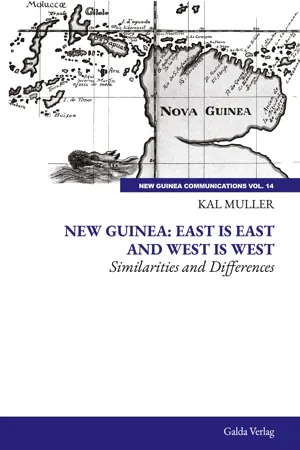
This book compares the two sides of New Guinea: the independent country of Papua New Guinea (PNG) and the West New Guinea (WNG) that forms a part of the Republic of Indonesia. By sharing the same island there are many similarities that apply to both sides such as the ethnic makeup in the eastern and western halves of New Guinea. Yet differences exist: geologies and geographies underlie some basic difference: outward maritime trade routes in the west focus toward the Moluccas while those in the east look towards the South Pacific. The inland trade routes are similar in the highlands following the dictates of the rugged terrain. Stone blades for axes and adzes were among the most important trade items everywhere, along with salt from local saline pools. The island's Babel of over 1, 100 languages has prevented any large-scale political entities. And while the art styles show some similarities, marked differences are found in the east and the west. The colonization process defines much of the current differences between the two sides. The west was colonized by the Dutch as part of their East Indies domain, now Indonesia. In the east, the British and the Germans were the first to take possession, with Australia taking over the entire west after 1914. Treatment of the Papuans differed considerably. In the west, it was almost complete neglect as the Dutch were mostly interested in the productive money generating parts of the East Indies, lacking in West New Guinea. In what became Papua New Guinea, working in plantations and gold mining depended on cheap Papuan labor, with their treatment showing considerable variation. World War II affected the two sides quite differently. The Japanese juggernaut rolled over the north coast of West New Guinea, then that of PNG before being stopped in the Solomon Islands. The expulsion of the Japanese took nearly three years on the PNG side but only a few months in WNG. This difference had profound effects, quite different on the two sides. The post war history in PNG headed for eventual independence in 1975 while WNG came to resemble an Indonesian colony with practically no political voice for the Papuans. Only a rebel movement contests Indonesian hegemony. The last chapter on mining shows the differences between the two sides on this most important element of their economies. Basic land ownership, individual and clan rights cause many problems in PNG while Indonesian control negated any difficulties for any mining approved by the central government in Jakarta.
- 589 pages
- English
- PDF
- Available on iOS & Android
eBook - PDF
About this book
Information
Table of contents
- New Guinea Communications
- Preface
- Introduction
- Photographs
- Geology
- Geography
- New Guinea Languages: Babel on an island
- Cultures of New Guinea
- Art in New Guinea: east and west compared
- Maritime trade networks
- Inland Trade
- Exploring New Guinea
- WW II
- Post WW II 1949 to 1969: Two decades that achieved Indonesian control in WNG
- Colonialism in NG: Dutch, British, German, Australian and Indonesian
- PNG to Independence
- Recent Developments in New Guinea
- MINING IN WNG and PNG
- Bibliography
- Port Moresby in 1895.
- Highlands gardens in WNG.
- A young man with a huge headdress.
- Alluvial gold mining in PNG in the 1920s.
- A Marind man named Barunda painted in the 1920s.
- The Kamoro village of Uta drawn in the 1800s.
- A monument to the ‘fuzzy-wuzzy angels’ in Port Moresby.
- The Dutch flag as well as the Morning Star flag flown at Hollandia.
- A poster showing a Papuan in WNG who the boss is in his lands.
- A Kamoro canoe arriving at an important festival.
- The Tasman Line, a geological phenomenon, follows the boundary between WNG and PNG.
- Alpine glacier lakes grace a valley between steep mountains.
- Limestone from shallow seas uplifted into mountains.
- The Telefomin area lies near PNG’s border with WNG.
- The central mountains of WNG drain to the north watershed.
- Broad, fertile valleys lie between PNGs’ central mountains.
- The Omba River drains Lake Yamur to the Arafura Sea.
- Fern trees thrive on a high inland plateau in WNG.
- Lake Sentani spreads near the large town of Jayapura in WNG.
- Triton Bay lies off the Arafura Sea, with the Lobo Village.
- Winging rivers cross the flat lands between the mountains and the south coast.
- Impassable rapids of the Baliem River tumble out of the Baliem Valley.
- The town of Enarotali lies on the shore of Lake Paniai.
- Trees and bushes cling to a limestone cliff in Bitsyari Bay.
- Austronesian and Papuan languages are the two major divisions in New Guinea.
- Frank Hurley plays voice and song recordings in the early 1920s.
- An American Evangelical missionary who spent many years learning a NAN language in WNG.
- A man in Alotau in PNG speaks one of the AN languages.
- A man from the Me group speaks one of the many NAN languages.
- The Wurm, Hattori map showing AN languages.
- The Wurm, Hattori map showing the easternmost highlands of WNG.
- The Silzer, Clouse map of the easternmost highlands of WNG.
- Agriculture provides basic sustenance in both WNG and PNG.
- Formerly, hunting was an important activity for men.
- Leadership in New Guinea depended on emphasis of different qualities.
- Warfare was prevalent in most New Guinea societies.
- A woman carries her baby in a loosely plaited net bag.
- Sorcery and witchcraft have been widely practiced in New Guinea.
- Women sell vegetable introduced by Europeans for the highlands.
- Carrots at the Goroka market in PNG.
- Malangan mask New Ireland, National Museum Port Moresby.
- A contemporary shield from the Sempan culture in WNG.
- Shields from the Gulf of Papua at Urama, early 1920s.
- Drums played during an initiation ritual of the Kamoro language group.
- A men’s house at a village called Bilibili in German New Guinea, 1880s.
- A sacred men’s house in Tobati Village, in Humboldt Bay, in WNG.
- Long-necked masks stand in front of a men’s house on the Gulf of New Guinea.
- Two Kamoro canoes under sail on a coastal estuary
- The traditional canoe just completing a trip around New Guinea.
- A large trading canoe from the Hermit Islands.
- Papuans from New Ireland greet Abel Tasman.
- Multi-hulled canoes carries long distance trade in the Gulf of Papua
- The ‘lakatoi’ rafts traded pots for sago form the west.
- A Kula trading canoe displayed at the Port Moresby Museum.
- Bronislaw Malinowski, the anthropologist who wrote The Argonauts of the Western Pacific about the Kula cycle.
- An armband as used in the Kula cycle, called ‘mwali’.
- An oval shaped sail propels a canoe in the China Strait.
- A salt pool in the highlands of WNG.
- Salt pool with man-made dam to retain the water.
- A Dani woman soaks banana trunks in a salt pool.
- The modern method of salt making is by boiling.
- A woman from the Moni tribe holds packaged salt.
- A chart showing what is traded in WNG for stone blades.
- A young Papuan trader on the trail near Lake Habbema.
- Stone blades lose their edge and must be re-sharpened.
- Fire is used to help detach rock chunks for making stone blade cores.
- A stone adze is still the tool of choice for splitting a pandanus fruit.
- The construction of a precarious bridge over a cataract keeps trade flowing.
- The huge hanging bridge spans the Baliem River at Wet-Pasema.
- A long line of porters with supplies for a patrol.
- The base camp of a Dutch expedition to the interior.
- The Dutch explorer H.A. Lorentz wearing a fantasy headdress.
- Dayak porters climbing over a snowfield toward Mt. Wilhelmina.
- The Russian explorer, M. Mikluho-Maclay, the first European explorer-scientist to live in New Guinea.
- Miklouho-Maclay, the Russian explorer, drew this dancer in 1972.
- A stone ax wielding man.
- Shortly after previous photo, Don Leahy is greeted by the Ax Man.
- The Leahy brothers established a working gold mine by 1936.
- A Dayak porter climbs next to a steep waterfall.
- Explorations in New Guinea used air drops for supplies.
- The Stirling Expedition used a hydroplane in 1936.
- Colijn, Wissel and Dozy stand on the (then) highest elevation in New Guinea, 1936.
- Census taking in PNG by patrol officer.
- A group of prisoners are manacled in the PNG highlands.
- The ‘Golden Stairs’ ease a notoriously difficult part of the Kokoda Trail.
- Papuan bearers ease a wounded Australian soldier down a steep slope.
- Australians were grateful to the ‘Fuzzy Wuzzy’ Angels.
- Papuan porter lights the cigarette of a wounded Australian soldier.
- Generals MacArthur and Blamey, the top Australian commander.
- Early in the day, the Japanese got along well with many Papuans.
- A Papuan sergeant on Bougainville Island who oversaw recruitment.
- Papuan soldiers in New Britain, ready to fight the Japanese.
- A Papuan in Merauke shows off to a Dutch, an American and an Australian.
- A Japanese shore battery has survived to this day in South WNG.
- American troops landing on the shore near the town of Hollandia.
- The Dutch official J.V. DeBruijn and his mini army in the highlands of WNG.
- A WW II monument on Biak Island was erected in three languages.
- The fuselage of a crashed US bomber on Numfor Island provided a home for a Papuan.
- A Papuan soldier felled by machine gun fire in 1945 receives medical attention.
- The Bay of Hollandia in the 1950s.
- The roads or safe anchorage area, off Manokwari.
- Sawmill at Manokwari
- A freighter landing copra.
- Training Papuan mechanics.
- Boys learn writing in a school.
- The hospital at Enarotali.
- A baby with malaria.
- Malaria testing.
- Sunday school in Enarotali.
- The Mokmer airport on Biak Island.
- A smiling Dutch nurse and a happy Papuan baby.
- The New Guinea Council in session, 5 April 1961.
- Indonesian parachutists ready to assault Dutch New Guinea.
- OPM highlands rebel with the Morning Star flag.
- A Papuan killed by the Indonesian army near the Freeport mine.
- Papuan demonstrators demand the closing of the Freeport mine.
- Indonesian paratroopers ready to be flown to Dutch New Guinea.
- An angry Papuan fighter draws a bow against colonialism.
- A propaganda poster encouraging Papuans to leave their primitive lifestyle.
- PNG Prime Minister Julius Chan and Indonesian President Suharto.
- Papuan local government council at Mt. Hagen.
- Rafts of canoes tied together traded clay pots for sago.
- A short coast road near Port Moresby, 1920s.
- A large dredger in the Bulolo gold fields area.
- A shortwave radio at home kept isolated families in touch during colonial times.
- Coffee plant in the central highlands.
- The town of Samarai, on an island off the eastern tip of New Guinea.
- A Chinese store in the Buka Passage.
- Simogun Peta, the first indigenous member of the Legislative Council.
- Queen Elizabeth meets Papuan artist Matias Kauge in Glasgow, 1996.
- Michael Somare, Independent PNG’s first prime minister.
- A new ‘tultul’ is presented to his village.
- A district officer signs on indentured recruits.
- Two Papuan nurses weigh a baby.
- An Australian women shops at the Goroka market.
- Bewigged porters carry a patrol officer’s belongings.
- Opening of the PNG House of Assembly, 1962.
- New Guinea Council opening Hollandia, 5th April 1961.
- The front of the PNG Parliament in Port Moresby.
- Local government councilors attending a House of Assembly session.
- A powerful portrait of a PNG women protesting rape.
- An airstrip construction perched precariously on a ridge among steep slopes.
- A painting of Christ as a Papuan graces a Catholic chapel.
- The modern Bank Papua building in Jayapura.
- The BSP Bank in Port Moresby with the PNG flag and Papuan motifs.
- A fire in the home in a remote mountain area of PNG.
- A rickety bridge connects a stretch of road in the WNG highlands.
- A large knife at the end of a long pole cuts off the fruit of the oil palm.
- Rice growing provides the preferred staple food for many in New Guinea.
- A road from Merauke on the south coast cuts through the red earth far inland.
- A thriving cabbage patch in the central highlands of New Guinea.
- An aerial view of the town of Kuala Kencana built by Freeport for its workers.
- A group of miners on Woodlark Island 1906
- A three-engine Junkers airplane flying to Bulolo in the 1920s.
- Buckets on the diffing ladder of a huge dredger at Bulolo.
- A dredger on the Fly River, near the Ok Tedi mine.
- The Ertsberg ore body, the site of the original Freeport Indonesia mine.
- Oil gushes out of an exploratory well dubbed Kuru 1.
- Oil flares during a successful test in the Kutubu discovery area.
- Men dig for alluvial gold in the Mt. Kare gold rush.
- A few crystalline nuggets occasionally reward many hours of cold labor.
- Freeport’s Grasberg mine in the early stages of development, c. 1996.
- The Grasberg open pit mine that was closed down by 2021.
- The river tailings from the Grasberg and mill attracts gold seekers.
- A Papuan miner wields a hand drill in the early days of underground mining.
Trusted by 375,005 students
Access to over 1.5 million titles for a fair monthly price.
Study more efficiently using our study tools.
Frequently asked questions
Yes, you can cancel anytime from the Subscription tab in your account settings on the Perlego website. Your subscription will stay active until the end of your current billing period. Learn how to cancel your subscription
No, books cannot be downloaded as external files, such as PDFs, for use outside of Perlego. However, you can download books within the Perlego app for offline reading on mobile or tablet. Learn how to download books offline
Perlego offers two plans: Essential and Complete
- Essential is ideal for learners and professionals who enjoy exploring a wide range of subjects. Access the Essential Library with 800,000+ trusted titles and best-sellers across business, personal growth, and the humanities. Includes unlimited reading time and Standard Read Aloud voice.
- Complete: Perfect for advanced learners and researchers needing full, unrestricted access. Unlock 1.5M+ books across hundreds of subjects, including academic and specialized titles. The Complete Plan also includes advanced features like Premium Read Aloud and Research Assistant.
We are an online textbook subscription service, where you can get access to an entire online library for less than the price of a single book per month. With over 1.5 million books across 990+ topics, we’ve got you covered! Learn about our mission
Look out for the read-aloud symbol on your next book to see if you can listen to it. The read-aloud tool reads text aloud for you, highlighting the text as it is being read. You can pause it, speed it up and slow it down. Learn more about Read Aloud
Yes! You can use the Perlego app on both iOS and Android devices to read anytime, anywhere — even offline. Perfect for commutes or when you’re on the go.
Please note we cannot support devices running on iOS 13 and Android 7 or earlier. Learn more about using the app
Please note we cannot support devices running on iOS 13 and Android 7 or earlier. Learn more about using the app
Yes, you can access New Guinea: East is East and West is West by Kal Muller in PDF and/or ePUB format, as well as other popular books in Social Sciences & Ethnic Studies. We have over 1.5 million books available in our catalogue for you to explore.