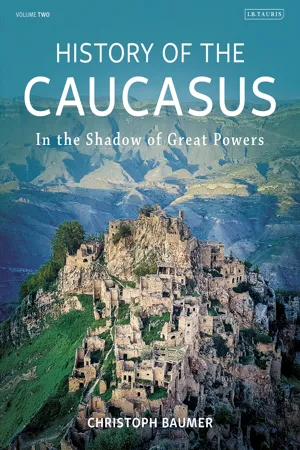
In the Shadow of Great Powers is the second volume of Christoph Baumer's History of the Caucasus. It covers the period from the Seljuk domination of the Southern Caucasus around 1050 CE to the present day. After the Kingdom of Georgia's golden age of independent power and cultural blossoming in the 12th and early 13th centuries, the Caucasus was overrun by the Mongols and soon disintegrated into innumerable smaller kingdoms, principalities and khanates. At the same time, an Armenian kingdom in exile maintained a precarious independence in Cilicia, today's southern Turkey, by applying a three-way diplomatic policy balanced between the Mongol Il-Khanate, the Crusader states and, to a lesser degree, the Mameluke Empire. Then followed four centuries during which the highly fragmented polities of the North and South Caucasus became political pawns of the regional great powers, above all the Ottomans, Iran and Russia.
In the wake of World War I the South Caucasus enjoyed a short-lived independence whereas its northern neighbours were engulfed by the Russian civil wars. But by 1921 the Soviet Union had re-established Russian dominance over the whole region and, from a Western perspective, the region 'disappeared' behind the Iron Curtain. Nevertheless, the Caucasian nations kept their pronounced identities even under Soviet rule, giving rise at the dissolution of the Soviet Union to a number of internecine conflicts. Whereas the Russian Federation managed to maintain its supremacy over the North Caucasus – albeit at the cost of bloody wars and insurrections – Armenia, Azerbaijan and Georgia succeeded in more or less gaining control over their destiny. Of these three republics, only Azerbaijan secured a wide-ranging independence thanks to its fossil fuel resources. Following Russian interference, Georgia lost control over two of its provinces while Armenia remains dependent on Russian support in the face of its notoriously antagonistic relations with neighbouring Azerbaijan and Turkey over the unresolved issue of Karabakh. In the Shadow of Great Powers includes some 200 full-colour images and maps which further bring the turbulent history of this region to light.
- 386 pages
- English
- PDF
- Available on iOS & Android
eBook - PDF
About this book
Information
Table of contents
- Cover
- Half-title
- Title
- Copyright
- Contents
- I. A Fragmented Identity: An Introduction to Contemporary Ethnic and Political Conditions in the Caucasus
- II. In the Wake of International Great-Power Politics
- III. The Armenian Kingdom of Cilicia
- IV. The South Caucasus under Turkmen, Ottoman and Iranian Safavid Domination
- V. First Russian Advances into the North Caucasus
- VI. The Caucasus under Russian Rule
- VII. A Short-Lived Independence and Foreign Interventions
- VIII. Under Soviet Rule
- IX. Independence in the South Caucasus
- X. Autonomy and Failed Independence in the North Caucasus
- XI. The Caucasus in the Twenty-First Century
- Appendix: Chronology of the most important Caucasian dynasties
- Notes
- Bibliography
- List of Maps
- Photo credits
- Acknowledgements
- Indexes
Trusted by 375,005 students
Access to over 1.5 million titles for a fair monthly price.
Study more efficiently using our study tools.
Frequently asked questions
Yes, you can cancel anytime from the Subscription tab in your account settings on the Perlego website. Your subscription will stay active until the end of your current billing period. Learn how to cancel your subscription
No, books cannot be downloaded as external files, such as PDFs, for use outside of Perlego. However, you can download books within the Perlego app for offline reading on mobile or tablet. Learn how to download books offline
Perlego offers two plans: Essential and Complete
- Essential is ideal for learners and professionals who enjoy exploring a wide range of subjects. Access the Essential Library with 800,000+ trusted titles and best-sellers across business, personal growth, and the humanities. Includes unlimited reading time and Standard Read Aloud voice.
- Complete: Perfect for advanced learners and researchers needing full, unrestricted access. Unlock 1.5M+ books across hundreds of subjects, including academic and specialized titles. The Complete Plan also includes advanced features like Premium Read Aloud and Research Assistant.
We are an online textbook subscription service, where you can get access to an entire online library for less than the price of a single book per month. With over 1.5 million books across 990+ topics, we’ve got you covered! Learn about our mission
Look out for the read-aloud symbol on your next book to see if you can listen to it. The read-aloud tool reads text aloud for you, highlighting the text as it is being read. You can pause it, speed it up and slow it down. Learn more about Read Aloud
Yes! You can use the Perlego app on both iOS and Android devices to read anytime, anywhere — even offline. Perfect for commutes or when you’re on the go.
Please note we cannot support devices running on iOS 13 and Android 7 or earlier. Learn more about using the app
Please note we cannot support devices running on iOS 13 and Android 7 or earlier. Learn more about using the app
Yes, you can access History of the Caucasus by Christoph Baumer in PDF and/or ePUB format, as well as other popular books in History & Asian History. We have over 1.5 million books available in our catalogue for you to explore.