Reuven Leigh provides the first in-depth introduction to the pioneering philosophy of Rabbi Shalom Ber Schneersohn. Bringing him into dialogue with key continental philosophers Emmanuel Levinas, Jacques Derrida and Julia Kristeva, this book reveals how Schneersohn's views anticipated many prominent themes in 20th-century thought.
Shalom Ber Schneersohn (1860-1920) was the fifth Rebbe of the Habad-Lubavitch dynasty. He was a traditional, kabbalistic thinker and yet, beyond mysticism, he wrote extensively on speech, gender and the body. So why is he not better known? Leigh begins by uncovering and contesting numerous scholarly assumptions that have operated to exclude traditional rabbinic thinkers from contemporary philosophical debates.
Seeking to correct this, this book offers a close reading of Schneersohn's 1898 discourses. With the disruption of traditional binary structures being the dominant theme pervading Schneersohn's work, Leigh engages with Levinas' provocative ideas on speech and the feminine. He also highlights how Derridean deconstruction involves a more positive approach to presence that was already anticipated in the writings of Schneersohn. And from the disruption of the hierarchy of signification to the semiotic aspect of language and the maternal body, this book demonstrates how Schneersohn foreshadows a number of Kristeva's central philosophical concerns.
A wide-ranging and inclusive volume, The Philosophy of Rabbi Shalom Ber Schneersohn demonstrates not only how forward-thinking Schneersohn's ideas were over a century ago, but how relevant they still are today.
eBook - ePub
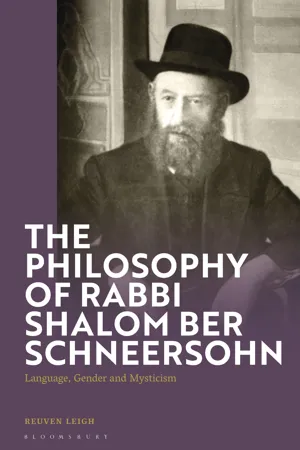
The Philosophy of Rabbi Shalom Ber Schneersohn
Language, Gender and Mysticism
- 256 pages
- English
- ePUB (mobile friendly)
- Available on iOS & Android
eBook - ePub
About this book
Information
Table of contents
- Cover
- Half-Title
- Series
- Dedication
- Title
- Contents
- Preface
- Acknowledgements
- Introduction
- 1 Background and context
- 2 Language
- 3 Gender
- 4 Mysticism
- Conclusion
- Bibliography
- Index
- Copyright
Trusted by 375,005 students
Access to over 1.5 million titles for a fair monthly price.
Study more efficiently using our study tools.
Frequently asked questions
Yes, you can cancel anytime from the Subscription tab in your account settings on the Perlego website. Your subscription will stay active until the end of your current billing period. Learn how to cancel your subscription
No, books cannot be downloaded as external files, such as PDFs, for use outside of Perlego. However, you can download books within the Perlego app for offline reading on mobile or tablet. Learn how to download books offline
Perlego offers two plans: Essential and Complete
- Essential is ideal for learners and professionals who enjoy exploring a wide range of subjects. Access the Essential Library with 800,000+ trusted titles and best-sellers across business, personal growth, and the humanities. Includes unlimited reading time and Standard Read Aloud voice.
- Complete: Perfect for advanced learners and researchers needing full, unrestricted access. Unlock 1.5M+ books across hundreds of subjects, including academic and specialized titles. The Complete Plan also includes advanced features like Premium Read Aloud and Research Assistant.
We are an online textbook subscription service, where you can get access to an entire online library for less than the price of a single book per month. With over 1.5 million books across 990+ topics, we’ve got you covered! Learn about our mission
Look out for the read-aloud symbol on your next book to see if you can listen to it. The read-aloud tool reads text aloud for you, highlighting the text as it is being read. You can pause it, speed it up and slow it down. Learn more about Read Aloud
Yes! You can use the Perlego app on both iOS and Android devices to read anytime, anywhere — even offline. Perfect for commutes or when you’re on the go.
Please note we cannot support devices running on iOS 13 and Android 7 or earlier. Learn more about using the app
Please note we cannot support devices running on iOS 13 and Android 7 or earlier. Learn more about using the app
Yes, you can access The Philosophy of Rabbi Shalom Ber Schneersohn by Reuven Leigh in PDF and/or ePUB format, as well as other popular books in Filosofía & Teología judía. We have over 1.5 million books available in our catalogue for you to explore.