Political conflict in many parts of the world has been shaped by notions of who rightfully belongs to a place. The concept of autochthony—that a true, original people are born of a land and belong to it above all others—has animated struggles across postcolonial Africa. But is this sense of rootedness from time immemorial necessary to assertions of original being and thus political supremacy? Belonging, Identity, and Conflict in the Central African Republic examines how political conflict unfolds when the language of autochthony is detached from historical land claims.
Focusing on violent struggles in the Central African Republic between 2012 and 2019, Gino Vlavonou explores the social practices, discursive strategies, and government policies that emerged in the relentless project of African state building. Conflict pitted Christian-animist communities, loosely organized as vigilante groups under the name anti-Balaka, against Muslim rebels known as the Séléka. Fighters of the anti-Balaka claimed that they were autochthonous, the "true Central Africans," reframing their Muslim neighbors as foreigners to be expelled. While the country had previously witnessed episodes of violence, both peoples had lived together relatively peacefully and intermarried. The speed and ferocity with which identity was weaponized puzzled many observers. To understand this phenomenon, Vlavonou probes autochthony as a category of identity that differs from ethnicity in important ways. He argues that elites and ordinary citizens alike mobilize the language of original belonging as "identity capital," a resource to be deployed. The value of that capital is lodged in what people say and do every day to give meaning to their identity, and its content changes across time and space.
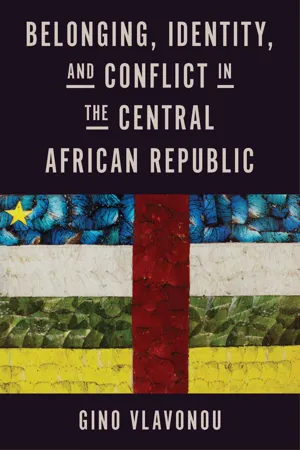
- 256 pages
- English
- PDF
- Available on iOS & Android
eBook - PDF
Belonging, Identity, and Conflict in the Central African Republic
About this book
Information
Table of contents
- Contents
- List of Illustrations
- Acknowledgments
- List of Abbreviations
- Introduction
- 1. Autochthony without Land
- 2. Civil Society and Armed Actors on Becoming Autochthonous
- 3. The Discursive Practices of François Bozizé
- 4. Autochthony without Land through State Policy and Mining
- 5. Autochthony, the Everyday, and Dynamics in the Public Market
- Conclusion: On Mobilizing Autochthony without Land
- Notes
- References
- Index
Trusted by 375,005 students
Access to over 1.5 million titles for a fair monthly price.
Study more efficiently using our study tools.
Frequently asked questions
Yes, you can cancel anytime from the Subscription tab in your account settings on the Perlego website. Your subscription will stay active until the end of your current billing period. Learn how to cancel your subscription
No, books cannot be downloaded as external files, such as PDFs, for use outside of Perlego. However, you can download books within the Perlego app for offline reading on mobile or tablet. Learn how to download books offline
Perlego offers two plans: Essential and Complete
- Essential is ideal for learners and professionals who enjoy exploring a wide range of subjects. Access the Essential Library with 800,000+ trusted titles and best-sellers across business, personal growth, and the humanities. Includes unlimited reading time and Standard Read Aloud voice.
- Complete: Perfect for advanced learners and researchers needing full, unrestricted access. Unlock 1.5M+ books across hundreds of subjects, including academic and specialized titles. The Complete Plan also includes advanced features like Premium Read Aloud and Research Assistant.
We are an online textbook subscription service, where you can get access to an entire online library for less than the price of a single book per month. With over 1.5 million books across 990+ topics, we’ve got you covered! Learn about our mission
Look out for the read-aloud symbol on your next book to see if you can listen to it. The read-aloud tool reads text aloud for you, highlighting the text as it is being read. You can pause it, speed it up and slow it down. Learn more about Read Aloud
Yes! You can use the Perlego app on both iOS and Android devices to read anytime, anywhere — even offline. Perfect for commutes or when you’re on the go.
Please note we cannot support devices running on iOS 13 and Android 7 or earlier. Learn more about using the app
Please note we cannot support devices running on iOS 13 and Android 7 or earlier. Learn more about using the app
Yes, you can access Belonging, Identity, and Conflict in the Central African Republic by Gino Vlavonou in PDF and/or ePUB format, as well as other popular books in History & African History. We have over 1.5 million books available in our catalogue for you to explore.