"A culinary mystery story leavened with Pallant's passion, charm, and devotion to the ageless allure of the risen loaf." —Aaron Bobrow-Strain, author of
White Bread
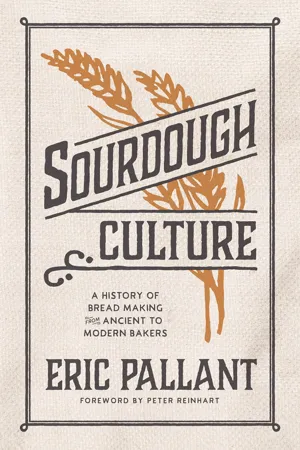
Sourdough Culture presents the history and rudimentary science of sourdough bread baking from its discovery more than six thousand years ago to its still-recent displacement by the innovation of dough-mixing machines and fast-acting yeast. Environmental science professor Eric Pallant traces the tradition of sourdough across continents, from its origins in the Middle East's Fertile Crescent to Europe and then around the world. Pallant also explains how sourdough fed some of history's most significant figures, such as Plato, Pliny the Elder, Louis Pasteur, Marie Antoinette, Martin Luther, and Antonie van Leeuwenhoek, and introduces the lesser-known—but equally important—individuals who relied on sourdough bread for sustenance: ancient Roman bakers, medieval housewives, Gold Rush miners, and the many, many others who have produced daily sourdough bread in anonymity.
Each chapter of
Sourdough Culture is accompanied by a selection from Pallant's own favorite recipes, which span millennia and traverse continents, and highlight an array of approaches, traditions, and methods to sourdough bread baking.
Sourdough Culture is a rich, informative, engaging read, especially for bakers—whether skilled or just beginners. More importantly, it tells the important and dynamic story of the bread that has fed the world.
"Pallant deftly covers a wide breadth of time and place in Sourdough Culture, interweaving experts' research with his own travels, research, and experiments." —
Pittsburgh City Paper
"A tour de force of social, economic, political, and gastronomic history that is both meticulously researched and highly readable." —Stanley Ginsberg, author of
The Rye Baker
- 344 pages
- English
- ePUB (mobile friendly)
- Available on iOS & Android
eBook - ePub
About this book
Information
Topic
ArtSubtopic
Social HistoryTable of contents
- Cover
- Title Page
- Copyright
- Dedication
- Contents
- Foreword
- Introduction
- Chapter 1 In the Beginning
- Chapter 2 Bread and Hunger
- Chapter 3 The French Connection
- Chapter 4 Sourdough Goes to America
- Chapter 5 A Reign of Yeast
- Chapter 6 How Much Bread Can You Buy with Gold?
- Chapter 7 Modern Bread
- Conclusion Final Proof
- Acknowledgments
- Endnotes
- Illustration Credits
- Index
- About the Author
Trusted by 375,005 students
Access to over 1.5 million titles for a fair monthly price.
Study more efficiently using our study tools.
Frequently asked questions
Yes, you can cancel anytime from the Subscription tab in your account settings on the Perlego website. Your subscription will stay active until the end of your current billing period. Learn how to cancel your subscription
No, books cannot be downloaded as external files, such as PDFs, for use outside of Perlego. However, you can download books within the Perlego app for offline reading on mobile or tablet. Learn how to download books offline
Perlego offers two plans: Essential and Complete
- Essential is ideal for learners and professionals who enjoy exploring a wide range of subjects. Access the Essential Library with 800,000+ trusted titles and best-sellers across business, personal growth, and the humanities. Includes unlimited reading time and Standard Read Aloud voice.
- Complete: Perfect for advanced learners and researchers needing full, unrestricted access. Unlock 1.5M+ books across hundreds of subjects, including academic and specialized titles. The Complete Plan also includes advanced features like Premium Read Aloud and Research Assistant.
We are an online textbook subscription service, where you can get access to an entire online library for less than the price of a single book per month. With over 1.5 million books across 990+ topics, we’ve got you covered! Learn about our mission
Look out for the read-aloud symbol on your next book to see if you can listen to it. The read-aloud tool reads text aloud for you, highlighting the text as it is being read. You can pause it, speed it up and slow it down. Learn more about Read Aloud
Yes! You can use the Perlego app on both iOS and Android devices to read anytime, anywhere — even offline. Perfect for commutes or when you’re on the go.
Please note we cannot support devices running on iOS 13 and Android 7 or earlier. Learn more about using the app
Please note we cannot support devices running on iOS 13 and Android 7 or earlier. Learn more about using the app
Yes, you can access Sourdough Culture by Eric Pallant in PDF and/or ePUB format, as well as other popular books in Art & Social History. We have over 1.5 million books available in our catalogue for you to explore.