This set of varied and stimulating papers, by an international group of younger as well as senior scholars, examines the manner in which peoplehood was understood by the Jewish communities of the Second Temple period and by the religious traditions that emerged from those communities and later flourished in Christianity and Rabbinic Judaism. The Hebrew and Greek terms for "people" and "nation" and the name "Israel" are closely analyzed, especially in forays into wisdom literature, Jewish apologetic and the Dead Sea Scrolls, and their uses are related to geographical, political and theological developments, as well as statehood, authority and rulership in the Persian world, Hasmonean times and Ptolemaic Egypt. Especially interesting are the carefully argued and documented suggestions about how Jewish peoplehood expressed itself with regard to charitable behavior, pagan deities, and marital regulations. Those interested in the history of cultural and theological tensions will be intrigued by the studies centered on how the opponents of Jews behaved towards "the people of God", how Hellenistic Jewish culture located the Jews on the Roman rather than on the Greek side, and how early Christian discourse saw the mission among the peoples and interpreted earlier sources accordingly. The idea of the Jewish "way of life" is seen to have influenced the writer of the longer Greek version of Esther and works of fiction are shown to have had important historical data within them. Modern social theory also has its say here in a careful consideration of Cognitive theory of ethnicity and the dynamic of ethnic boundary-making.
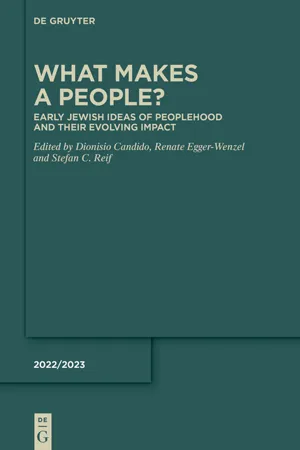
eBook - ePub
What Makes a People?
Early Jewish Ideas of Peoplehood and Their Evolving Impact
- 330 pages
- English
- ePUB (mobile friendly)
- Available on iOS & Android
eBook - ePub
What Makes a People?
Early Jewish Ideas of Peoplehood and Their Evolving Impact
About this book
Information
Topic
Theology & ReligionSubtopic
Biblical StudiesTable of contents
- Title Page
- Copyright
- Contents
- Social Conflicts in the Persian Period: Yehud, Elephantine and Samaria
- What Makes a People According to Israel’s Wisdom Literature? ἔθνος and ἔθνη in Proverbs, Wisdom of Sirach and Wisdom of Solomon
- Laos in the First Book of Maccabees: A Hasmonean Perspective in the Context of Limited Statehood
- Sociology of Ben Sira’s Patriarchal Society: Textual and Papyrological Perspectives
- Ben Sira’s Catalogue of Generosity (Sir 7:32‒36)
- “When one is wise to his people’s advantage” (Sir 37:23): Political Intelligence in the Book of Ben Sira
- Konfrontationen. Die Kontrahenten des Volkes im Buch der Weisheit
- Die jüdische Lebensweise in den griechischen Versionen des Buches Esther
- The Identity of “Israel” in the Book of Tobit: How to Create an ethnos?
- The Heroes of the Book of Tobit as Figures of the Assyrian Diaspora
- “For we are the sons of the prophets”: The Idea of a People in the Book of Tobit
- Which Idols? The Criticism of Idolatry in the Epistle of Jeremiah (Bar 6)
- What Makes a People in the Dead Sea Scrolls?
- Entangled Jewish Identities in Rome. The Case of “Barbarians” in Philo and Josephus
- μαθητεύσατε πάντα τὰ ἔθνη (Matt 28:19): Jesus’s Cosmocracy and the Universalization of Discipleship–an “Inclusive” Reading
- The Mixed Marriage Crisis (Ezra 9‒10, Nehemiah 13), and Its Resonance in Jewish Law and Lore
- The Notion of the Nation: How Hebrew Terminology Has Adjusted to Changing Circumstances—A Tale of Cultural Semantics
- Index of Subjects
- Index of Modern Authors
- Index of Sources
Trusted by 375,005 students
Access to over 1.5 million titles for a fair monthly price.
Study more efficiently using our study tools.
Frequently asked questions
Yes, you can cancel anytime from the Subscription tab in your account settings on the Perlego website. Your subscription will stay active until the end of your current billing period. Learn how to cancel your subscription
No, books cannot be downloaded as external files, such as PDFs, for use outside of Perlego. However, you can download books within the Perlego app for offline reading on mobile or tablet. Learn how to download books offline
Perlego offers two plans: Essential and Complete
- Essential is ideal for learners and professionals who enjoy exploring a wide range of subjects. Access the Essential Library with 800,000+ trusted titles and best-sellers across business, personal growth, and the humanities. Includes unlimited reading time and Standard Read Aloud voice.
- Complete: Perfect for advanced learners and researchers needing full, unrestricted access. Unlock 1.5M+ books across hundreds of subjects, including academic and specialized titles. The Complete Plan also includes advanced features like Premium Read Aloud and Research Assistant.
We are an online textbook subscription service, where you can get access to an entire online library for less than the price of a single book per month. With over 1.5 million books across 990+ topics, we’ve got you covered! Learn about our mission
Look out for the read-aloud symbol on your next book to see if you can listen to it. The read-aloud tool reads text aloud for you, highlighting the text as it is being read. You can pause it, speed it up and slow it down. Learn more about Read Aloud
Yes! You can use the Perlego app on both iOS and Android devices to read anytime, anywhere — even offline. Perfect for commutes or when you’re on the go.
Please note we cannot support devices running on iOS 13 and Android 7 or earlier. Learn more about using the app
Please note we cannot support devices running on iOS 13 and Android 7 or earlier. Learn more about using the app
Yes, you can access What Makes a People? by Dionisio Candido,Renate Egger-Wenzel,Stefan C. Reif in PDF and/or ePUB format, as well as other popular books in Theology & Religion & Biblical Studies. We have over 1.5 million books available in our catalogue for you to explore.