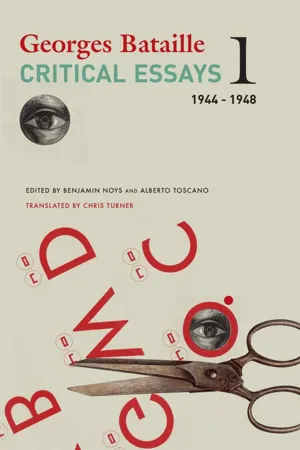
This first book in a three-volume collection of Georges Bataille's essays introduces English readers to his philosophical and critical writings.
In the aftermath of the Second World War, French thinker and writer Georges Bataille forged a singular path through the moral and political impasses of his age. In 1946, animated by "a need to live events in an increasingly conscious way," and to reject any compartmentalization of intellectual life, Bataille founded the journal Critique. Adopting the format of the review essay, he surveyed the post-war cultural landscape while advancing his reflections on excess, non-knowledge, and the general economy. Focusing on literature as a mode of sovereign uselessness, he tackled prominent and divisive figures such as Henry Miller and Albert Camus.
In keeping with Critique's mission to explore the totality of human knowledge, Bataille's articles did not just focus on the literary but featured important reflections on the science of sexuality, the Chinese Revolution, and historical accounts of drunkenness, among other matters. Throughout, he was attuned to how humanity would deal with the excessive forces of production and destruction it had unleashed, his aim being a way of thinking and living that would inhabit that excess.
This is the first of three volumes collecting Bataille's post-war essays. Beginning with an article on Nietzsche and fascism written shortly after the liberation of Paris and running to the end of 1948, these texts make available for the first time in English the systematic diversity of Bataille's post-war thought.
eBook - ePub
Critical Essays: Volume 1
1944–1948
- 400 pages
- English
- ePUB (mobile friendly)
- Available on iOS & Android
eBook - ePub
About this book
Information
Table of contents
- Bataille’s Copyright page
- editors’ introduction At the Crossroads: The Postwar Bataille
- Translator’s Note
- 1944
- Is Nietzsche Fascist?
- Is Literature Useful?
- 1945
- The Will to the Impossible
- Picasso’s Political Paintings
- On Ernest Hemingway’s For Whom the Bell Tolls
- 1946
- Klee
- Miller’s Morality
- Dionysos Redivivus
- Mystical Experience and Literature
- The Indictment of Henry Miller
- Gide – Baranger – Gillet
- The Last Instant
- Gide – Nietzsche – Claudel
- Take It or Leave It
- The War in China
- Cossery – Robert Aron
- Marcel Proust and the Profaned Mother
- Adamov
- 1947
- The Friendship between Man and Beast
- Giraud – Pastoureau – Benda –Du Moulin de Laplante – Govy
- On the Relationship between the Divine and Evil
- Pierre Gordon
- What Is Sex?
- A New American Novelist
- Sartre
- A Morality Based on Misfortune: The Plague
- Letter to Merleau-Ponty
- Is Lasting Peace Inevitable?
- Joseph Conrad
- Preface to the Gaston-Louis Roux Exhibition
- From Existentialism to the Primacy of the Economy
- 1948
- Goya
- Psychoanalysis
- Tavern Drunkenness and Religion
- Political Lying
- The Sexual Revolution and the Kinsey Report
- Jean Paulhan – Marc Bloch
- On the Meaning of Moral Neutrality in the Russo-American War
- The Divinity of Isou
- The Mischievousness of Language
- Marcel Proust
- Bibliography and Notes
Trusted by 375,005 students
Access to over 1.5 million titles for a fair monthly price.
Study more efficiently using our study tools.
Frequently asked questions
Yes, you can cancel anytime from the Subscription tab in your account settings on the Perlego website. Your subscription will stay active until the end of your current billing period. Learn how to cancel your subscription
No, books cannot be downloaded as external files, such as PDFs, for use outside of Perlego. However, you can download books within the Perlego app for offline reading on mobile or tablet. Learn how to download books offline
Perlego offers two plans: Essential and Complete
- Essential is ideal for learners and professionals who enjoy exploring a wide range of subjects. Access the Essential Library with 800,000+ trusted titles and best-sellers across business, personal growth, and the humanities. Includes unlimited reading time and Standard Read Aloud voice.
- Complete: Perfect for advanced learners and researchers needing full, unrestricted access. Unlock 1.5M+ books across hundreds of subjects, including academic and specialized titles. The Complete Plan also includes advanced features like Premium Read Aloud and Research Assistant.
We are an online textbook subscription service, where you can get access to an entire online library for less than the price of a single book per month. With over 1.5 million books across 990+ topics, we’ve got you covered! Learn about our mission
Look out for the read-aloud symbol on your next book to see if you can listen to it. The read-aloud tool reads text aloud for you, highlighting the text as it is being read. You can pause it, speed it up and slow it down. Learn more about Read Aloud
Yes! You can use the Perlego app on both iOS and Android devices to read anytime, anywhere — even offline. Perfect for commutes or when you’re on the go.
Please note we cannot support devices running on iOS 13 and Android 7 or earlier. Learn more about using the app
Please note we cannot support devices running on iOS 13 and Android 7 or earlier. Learn more about using the app
Yes, you can access Critical Essays: Volume 1 by Georges Bataille, Benjamin Noys,Alberto Toscano, Chris Turner in PDF and/or ePUB format, as well as other popular books in Literature & Literary Criticism. We have over 1.5 million books available in our catalogue for you to explore.