By bringing together philosophers whose work on political philosophy, intellectual history, and world philosophies pushes the boundaries of conventional scholarship, this collaborative collection opens up space in political philosophy for new approaches.
Garrick Cooper, Sudipta Kaviraj, Charles W. Mills, and Sor-hoon Tan respond to the challenges James Tully raises for comparative political thought. Arranged around Tully's opening chapter, they demonstrate the value of critical dialogue and point to the different attempts cultures make to understand their experiences. Through the use of methods from various disciplines and cultural contexts, each interlocutor exemplifies the transformative power of genuine democratic dialogue across philosophical traditions. Together they call for a radical reorientation of conceptual and intellectual readings from intellectual history including the Afro-modern political tradition, Indigenous philosophies, and the lived experiences of societies in Asia.
This is an urgent methodological provocation for anyone interested in the ethical, conceptual, and political challenges of political thought today.
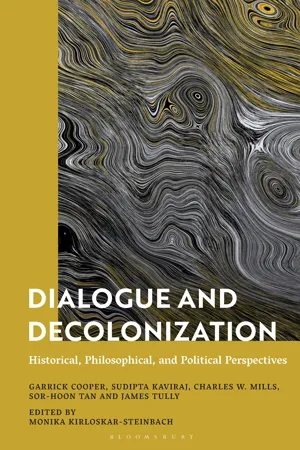
eBook - ePub
Dialogue and Decolonization
Historical, Philosophical, and Political Perspectives
- 216 pages
- English
- ePUB (mobile friendly)
- Available on iOS & Android
eBook - ePub
Dialogue and Decolonization
Historical, Philosophical, and Political Perspectives
About this book
Information
Table of contents
- Cover
- Halftitle Page
- Title Page
- Contents
- Acknowledgments
- 1 Deparochializing Political Theory and Beyond: A Dialogue Approach to Comparative Political Thought
- 2 A Conversation with James Tully’s “Deparochializing Political Theory and Beyond”
- 3 Whose Tradition? Which Practices?
- 4 Historicizing Political Theory
- 5 Dialogues in Black and White
- 6 Continuing the Dialogue
- Afterword: Concluding Reflections
- Contributors
- Index
- Imprint
Trusted by 375,005 students
Access to over 1.5 million titles for a fair monthly price.
Study more efficiently using our study tools.
Frequently asked questions
Yes, you can cancel anytime from the Subscription tab in your account settings on the Perlego website. Your subscription will stay active until the end of your current billing period. Learn how to cancel your subscription
No, books cannot be downloaded as external files, such as PDFs, for use outside of Perlego. However, you can download books within the Perlego app for offline reading on mobile or tablet. Learn how to download books offline
Perlego offers two plans: Essential and Complete
- Essential is ideal for learners and professionals who enjoy exploring a wide range of subjects. Access the Essential Library with 800,000+ trusted titles and best-sellers across business, personal growth, and the humanities. Includes unlimited reading time and Standard Read Aloud voice.
- Complete: Perfect for advanced learners and researchers needing full, unrestricted access. Unlock 1.5M+ books across hundreds of subjects, including academic and specialized titles. The Complete Plan also includes advanced features like Premium Read Aloud and Research Assistant.
We are an online textbook subscription service, where you can get access to an entire online library for less than the price of a single book per month. With over 1.5 million books across 990+ topics, we’ve got you covered! Learn about our mission
Look out for the read-aloud symbol on your next book to see if you can listen to it. The read-aloud tool reads text aloud for you, highlighting the text as it is being read. You can pause it, speed it up and slow it down. Learn more about Read Aloud
Yes! You can use the Perlego app on both iOS and Android devices to read anytime, anywhere — even offline. Perfect for commutes or when you’re on the go.
Please note we cannot support devices running on iOS 13 and Android 7 or earlier. Learn more about using the app
Please note we cannot support devices running on iOS 13 and Android 7 or earlier. Learn more about using the app
Yes, you can access Dialogue and Decolonization by Monika Kirloskar-Steinbach in PDF and/or ePUB format, as well as other popular books in Philosophy & Political Philosophy. We have over 1.5 million books available in our catalogue for you to explore.