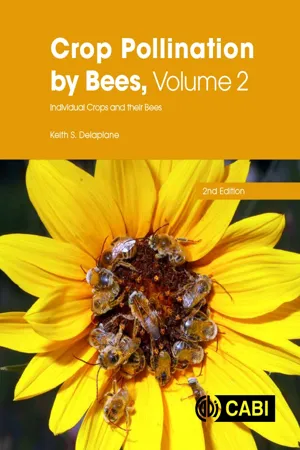
Since the second half of the 20th Century, our agricultural bee pollinators have faced mounting threats from ecological disturbance and pan-global movement of pathogens and parasites. At the same time, the area of pollinator-dependent crops is increasing globally with no end in sight. Never before has so much been asked of our finite pool of bee pollinators. This book not only explores the evolutionary and ecologic bases of these dynamics, it translates this knowledge into practical research-based guidance for using bees to pollinate crops. It emphasizes conserving wild bee populations as well as culturing honey bees, bumble bees, and managed solitary bees. To cover such a range of biology, theory, and practice from the perspectives of both the pollinator and the crop, the book is divided into two volumes. Volume 1 focuses on bees, their biology, coevolution with flowering plants, foraging ecology and management, and gives practical ways to increase bee abundance and pollinating performance on the farm. Volume 2 (this volume) focuses on crops, with chapters addressing crop-specific requirements and bee pollination management recommendations.Both volumes are essential reading for farmers, horticulturists and gardeners, researchers and professionals working in insect ecology and conservation, and students of entomology and crop protection.
- 344 pages
- English
- ePUB (mobile friendly)
- Available on iOS & Android
eBook - ePub
About this book
Information
Table of contents
- Cover
- Halftitle
- Title
- Copyright
- Contents
- Author Biography
- Preface to the 2000 Edition
- Preface to the 2023 Edition
- Acknowledgements
- 1 Pesticides and Crop Pollination by Bees
- 2 Alfalfa (Lucerne) Seed
- 3 Allspice (Pimento)
- 4 Almond
- 5 Apple
- 6 Apricot
- 7 Asparagus Seed
- 8 Avocado
- 9 Bean, Faba, Broad
- 10 Bean, Field, Hyacinth, Indian, Lablab
- 11 Bean, Jack, Horse, Feijão de Porco, Swordbean
- 12 Bean, Soy, Soybean
- 13 Black Currant, Red Currant
- 14 Blackberry
- 15 Blueberry
- 16 Brazil Nut
- 17 Buckwheat
- 18 Cabbage, Cauliflower and other Crucifer Seed
- 19 Cantaloupe, Honeydew, Melon, Muskmelon
- 20 Cardamom
- 21 Carrot
- 22 Cashew
- 23 Clover Seed (Alsike)
- 24 Clover Seed (Crimson)
- 25 Clover Seed (Red)
- 26 Clover Seed (White, Dutch, Ladino)
- 27 Clover Seed (Sweet)
- 28 Cocoa
- 29 Coffee
- 30 Cranberry
- 31 Cucumber
- 32 Feijoa
- 33 Guava
- 34 Kiwifruit
- 35 Loquat
- 36 Macadamia
- 37 Mango
- 38 Onion Seed
- 39 Passion Fruit
- 40 Peach and Nectarine
- 41 Pear
- 42 Plum and Prune
- 43 Pumpkin, Squash
- 44 Rapeseed, Canola
- 45 Raspberry
- 46 Rosehips
- 47 Shea Nut
- 48 Star Fruit
- 49 Strawberry
- 50 Sunflower
- 51 Sweet and Sour Cherry
- 52 Tomato
- 53 Vanilla
- 54 Watermelon
- Index
- Backcover
Trusted by 375,005 students
Access to over 1.5 million titles for a fair monthly price.
Study more efficiently using our study tools.
Frequently asked questions
Yes, you can cancel anytime from the Subscription tab in your account settings on the Perlego website. Your subscription will stay active until the end of your current billing period. Learn how to cancel your subscription
No, books cannot be downloaded as external files, such as PDFs, for use outside of Perlego. However, you can download books within the Perlego app for offline reading on mobile or tablet. Learn how to download books offline
Perlego offers two plans: Essential and Complete
- Essential is ideal for learners and professionals who enjoy exploring a wide range of subjects. Access the Essential Library with 800,000+ trusted titles and best-sellers across business, personal growth, and the humanities. Includes unlimited reading time and Standard Read Aloud voice.
- Complete: Perfect for advanced learners and researchers needing full, unrestricted access. Unlock 1.5M+ books across hundreds of subjects, including academic and specialized titles. The Complete Plan also includes advanced features like Premium Read Aloud and Research Assistant.
We are an online textbook subscription service, where you can get access to an entire online library for less than the price of a single book per month. With over 1.5 million books across 990+ topics, we’ve got you covered! Learn about our mission
Look out for the read-aloud symbol on your next book to see if you can listen to it. The read-aloud tool reads text aloud for you, highlighting the text as it is being read. You can pause it, speed it up and slow it down. Learn more about Read Aloud
Yes! You can use the Perlego app on both iOS and Android devices to read anytime, anywhere — even offline. Perfect for commutes or when you’re on the go.
Please note we cannot support devices running on iOS 13 and Android 7 or earlier. Learn more about using the app
Please note we cannot support devices running on iOS 13 and Android 7 or earlier. Learn more about using the app
Yes, you can access Crop Pollination by Bees, Volume 2 by Keith S Delaplane in PDF and/or ePUB format, as well as other popular books in Biological Sciences & Entomology. We have over 1.5 million books available in our catalogue for you to explore.