An innovative analysis that traces the continuity of the state’s custodianship of Islam as the preferred religion in the Middle East and North Africa
In The Making of the Modern Muslim State, Malika Zeghal reframes the role of Islam in modern Middle East governance. Challenging other accounts that claim that Middle Eastern states turned secular in modern times, Zeghal shows instead the continuity of the state’s custodianship of Islam as the preferred religion. Drawing on intellectual, political, and economic history, she traces this custodianship from early forms of constitutional governance in the nineteenth century through post–Arab Spring experiments in democracy. Zeghal argues that the intense debates around the implementation and meaning of state support for Islam led to a political cleavage between conservatives and their opponents that long predated the polarization of the twentieth century that accompanied the emergence of mass politics and Islamist movements.
Examining constitutional projects, public spending, school enrollments, and curricula, Zeghal shows that although modern Muslim-majority polities have imported Western techniques of governance, the state has continued to protect and support the religion, community, and institutions of Islam. She finds that even as Middle Eastern states have expanded their nonreligious undertakings, they have dramatically increased their per capita supply of public religious provisions, especially Islamic education—further feeding the political schism between Islamists and their adversaries. Zeghal illuminates the tensions inherent in the partnerships between states and the body of Muslim scholars known as the ulama, whose normative power has endured through a variety of political regimes. Her detailed and groundbreaking analysis, which spans Tunisia, Morocco, Egypt, Turkey, Syria, and Lebanon, makes clear the deep historical roots of current political divisions over Islam in governance.
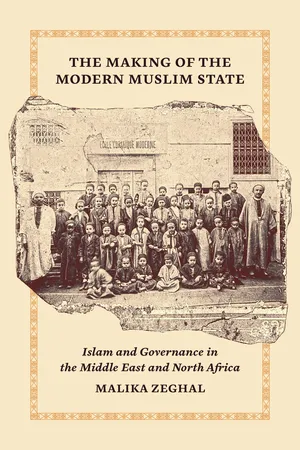
eBook - ePub
The Making of the Modern Muslim State
Islam and Governance in the Middle East and North Africa
- 328 pages
- English
- ePUB (mobile friendly)
- Available on iOS & Android
eBook - ePub
The Making of the Modern Muslim State
Islam and Governance in the Middle East and North Africa
About this book
Information
Publisher
Princeton University PressYear
2024Print ISBN
9780691134369
9780691259673
eBook ISBN
9780691189031
Table of contents
- Cover
- Series Page
- Title Page
- Copyright
- Dedication
- Contents
- List of Tables
- Note on Transliterations
- Acknowledgments
- Abbreviations
- Introduction
- 1. The State’s Enduring Custodianship of Islam: Old Ideals and New Techniques of Governance in the Regency of Tunis’s 1861 Constitution
- 2. Competing Custodians of Islam in the 1907–1959 Tunisian Constitutional Episode: Islamic France, the Bey, and Independent Tunisia
- 3. State Custodianship of Islam in the Tunisian 2014 Constitution: Debating a Muslim and Democratic State
- 4. The Political Cleavage about Islam in Governance in the Modern Middle East: A Reappraisal
- 5. The Concrete Implementation of the State’s Custodianship of Islam in the Longue Durée and Its Discontents
- Conclusion
- Tables
- Data Appendix
- Bibliography
- Index
Trusted by 375,005 students
Access to over 1.5 million titles for a fair monthly price.
Study more efficiently using our study tools.
Frequently asked questions
Yes, you can cancel anytime from the Subscription tab in your account settings on the Perlego website. Your subscription will stay active until the end of your current billing period. Learn how to cancel your subscription
No, books cannot be downloaded as external files, such as PDFs, for use outside of Perlego. However, you can download books within the Perlego app for offline reading on mobile or tablet. Learn how to download books offline
Perlego offers two plans: Essential and Complete
- Essential is ideal for learners and professionals who enjoy exploring a wide range of subjects. Access the Essential Library with 800,000+ trusted titles and best-sellers across business, personal growth, and the humanities. Includes unlimited reading time and Standard Read Aloud voice.
- Complete: Perfect for advanced learners and researchers needing full, unrestricted access. Unlock 1.5M+ books across hundreds of subjects, including academic and specialized titles. The Complete Plan also includes advanced features like Premium Read Aloud and Research Assistant.
We are an online textbook subscription service, where you can get access to an entire online library for less than the price of a single book per month. With over 1.5 million books across 990+ topics, we’ve got you covered! Learn about our mission
Look out for the read-aloud symbol on your next book to see if you can listen to it. The read-aloud tool reads text aloud for you, highlighting the text as it is being read. You can pause it, speed it up and slow it down. Learn more about Read Aloud
Yes! You can use the Perlego app on both iOS and Android devices to read anytime, anywhere — even offline. Perfect for commutes or when you’re on the go.
Please note we cannot support devices running on iOS 13 and Android 7 or earlier. Learn more about using the app
Please note we cannot support devices running on iOS 13 and Android 7 or earlier. Learn more about using the app
Yes, you can access The Making of the Modern Muslim State by Malika Zeghal in PDF and/or ePUB format, as well as other popular books in Social Sciences & Middle Eastern Politics. We have over 1.5 million books available in our catalogue for you to explore.