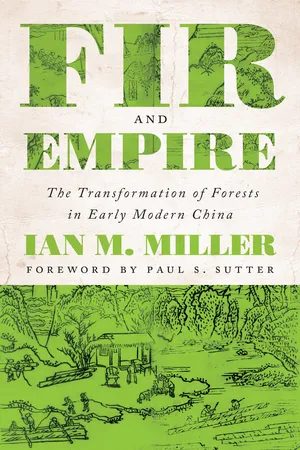
Fir and Empire
The Transformation of Forests in Early Modern China
- 296 pages
- English
- ePUB (mobile friendly)
- Available on iOS & Android
About this book
A CHOICE OUTSTANDING ACADEMIC TITLE Restores China's place in forest history The disappearance of China's naturally occurring forests is one of the most significant environmental shifts in the country's history, one often blamed on imperial demand for lumber. China's early modern forest history is typically viewed as a centuries-long process of environmental decline, culminating in a nineteenth-century social and ecological crisis. Pushing back against this narrative of deforestation, Ian Miller charts the rise of timber plantations between about 1000 and 1700, when natural forests were replaced with anthropogenic ones. Miller demonstrates that this form of forest management generally rested on private ownership under relatively distant state oversight and taxation. He further draws on in-depth case studies of shipbuilding and imperial logging to argue that this novel landscape was not created through simple extractive pressures, but by attempts to incorporate institutional and ecological complexity into a unified imperial state. Miller uses the emergence of anthropogenic forests in south China to rethink both temporal and spatial frameworks for Chinese history and the nature of Chinese empire. Because dominant European forestry models do not neatly overlap with the non-Western world, China's history is often left out of global conversations about them; Miller's work rectifies this omission and suggests that in some ways, China's forest system may have worked better than the more familiar European institutions. The open access publication of this book was made possible by a grant from the James P. Geiss and Margaret Y. Hsu Foundation.
Frequently asked questions
- Essential is ideal for learners and professionals who enjoy exploring a wide range of subjects. Access the Essential Library with 800,000+ trusted titles and best-sellers across business, personal growth, and the humanities. Includes unlimited reading time and Standard Read Aloud voice.
- Complete: Perfect for advanced learners and researchers needing full, unrestricted access. Unlock 1.4M+ books across hundreds of subjects, including academic and specialized titles. The Complete Plan also includes advanced features like Premium Read Aloud and Research Assistant.
Please note we cannot support devices running on iOS 13 and Android 7 or earlier. Learn more about using the app.
Information
Table of contents
- Cover
- Series Page
- Title Page
- Copyright
- Dedication
- Contents
- Foreword: The Great Reforestation, by Paul S. Sutter
- Acknowledgments
- List of Maps, Figures, and Tables
- Naming Conventions
- Introduction
- One: The End of Abundance
- Two: Boundaries, Taxes, and Property Rights
- Three: Hunting Households and Sojourner Families
- Four: Deeds, Shares, and Pettifoggers
- Five: Wood and Water, Part I: Tariff Timber
- Six: Wood and Water, Part II: Naval Timber
- Seven: Beijing Palaces and the Ends of Empire
- Conclusion
- Appendix A: Forests in Tax Data
- Appendix B: Note on Sources
- Glossary
- Notes
- Bibliography
- Index
- Series List