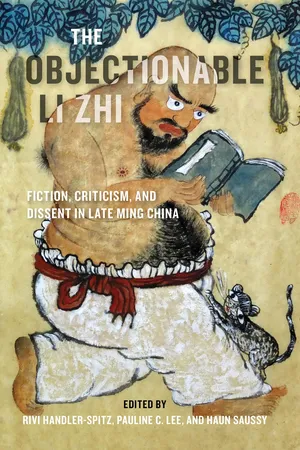
The Objectionable Li Zhi
Fiction, Criticism, and Dissent in Late Ming China
- 296 pages
- English
- ePUB (mobile friendly)
- Available on iOS & Android
The Objectionable Li Zhi
Fiction, Criticism, and Dissent in Late Ming China
About this book
Astute inquiries into the world of China's most unconventional early modern intellectual Iconoclastic scholar Li Zhi (1527–1602) was a central figure in the cultural world of the late Ming dynasty. His provocative and controversial words and actions shaped print culture, literary practice, attitudes toward gender, and perspectives on Buddhism and the afterlife. Although banned, his writings were never fully suppressed, because they tapped into issues of vital significance to generations of readers. His incisive remarks, along with the emotional intensity and rhetorical power with which he delivered them, made him an icon of his cultural moment and an emblem of early modern Chinese intellectual dissent. In this volume, leading China scholars demonstrate the interrelatedness of seemingly discrete aspects of Li Zhi's thought and emphasize his far-reaching impact on his contemporaries and successors. In doing so, they challenge the myth that there was no tradition of dissidence in premodern China. The open access publication of this book was made possible by a grant from the James P. Geiss and Margaret Y. Hsu Foundation.
Frequently asked questions
- Essential is ideal for learners and professionals who enjoy exploring a wide range of subjects. Access the Essential Library with 800,000+ trusted titles and best-sellers across business, personal growth, and the humanities. Includes unlimited reading time and Standard Read Aloud voice.
- Complete: Perfect for advanced learners and researchers needing full, unrestricted access. Unlock 1.4M+ books across hundreds of subjects, including academic and specialized titles. The Complete Plan also includes advanced features like Premium Read Aloud and Research Assistant.
Please note we cannot support devices running on iOS 13 and Android 7 or earlier. Learn more about using the app.
Information
Table of contents
- Cover
- Title Page
- Copyright
- Contents
- Acknowledgments
- Introduction
- Part I. Authenticity and Filiality
- Part II. Friends and Teachers
- Part III. Manipulations of Gender
- Part IV. Textual Communities
- Part V. Afterlives
- Glossary
- Bibliography
- Contributors
- Index