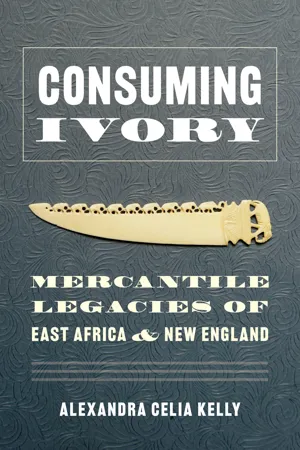
Consuming Ivory
Mercantile Legacies of East Africa and New England
- 278 pages
- English
- ePUB (mobile friendly)
- Available on iOS & Android
Consuming Ivory
Mercantile Legacies of East Africa and New England
About this book
Examines the complex global impact of the ivory trade The economic prosperity of two nineteenth- and early-twentieth-century New England towns rested on factories that manufactured piano keys, billiard balls, combs, and other items made of ivory imported from East Africa. Yet while towns like Ivoryton and Deep River, Connecticut, thrived, the African ivory trade left in its wake massive human exploitation and ecological devastation. At the same time, dynamic East African engagement with capitalism and imperialism took place within these trade histories. Drawing from extensive archival and field research in New England, Great Britain, and Tanzania, Alexandra Kelly investigates the complex global legacies of the historical ivory trade. She not only explains the complexities of this trade but also analyzes Anglo-American narratives about Africa, questioning why elephants and ivory feature so centrally in those representations. From elephant conservation efforts to the cultural heritage industries in New England and East Africa, her study reveals the ongoing global repercussions of the ivory craze and will be of interest to anthropologists, archaeologists, historians, and conservationists.
Frequently asked questions
- Essential is ideal for learners and professionals who enjoy exploring a wide range of subjects. Access the Essential Library with 800,000+ trusted titles and best-sellers across business, personal growth, and the humanities. Includes unlimited reading time and Standard Read Aloud voice.
- Complete: Perfect for advanced learners and researchers needing full, unrestricted access. Unlock 1.4M+ books across hundreds of subjects, including academic and specialized titles. The Complete Plan also includes advanced features like Premium Read Aloud and Research Assistant.
Please note we cannot support devices running on iOS 13 and Android 7 or earlier. Learn more about using the app.
Information
Table of contents
- Cover
- Series Announcement Page
- Title Page
- Copyright
- Dedication
- Contents
- Foreword by K. Sivaramakrishnan
- Preface
- Acknowledgments
- Introduction: The Towns That Elephants Built
- Chapter One. A History of the Ivory Trade
- Chapter Two. Consuming Elephants, Consuming Empire
- Chapter Three. Problem Elephants and the Formation of a Conservation Ethos
- Chapter Four. The Ivory Museum and the Materiality of Heritage
- Chapter Five. The Heritage Industry in East Africa
- Conclusion: Notes from the Ivory Tower
- Notes
- Works Cited
- Index
- Series List