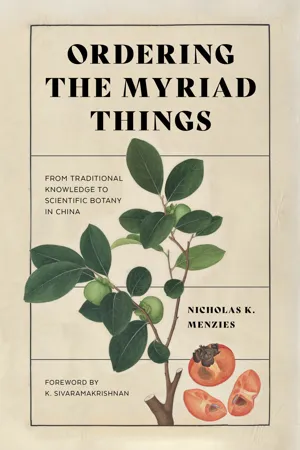
Ordering the Myriad Things
From Traditional Knowledge to Scientific Botany in China
- 312 pages
- English
- PDF
- Available on iOS & Android
Ordering the Myriad Things
From Traditional Knowledge to Scientific Botany in China
About this book
Winner of the 2024 SHNH Natural History Book Prize (The John Thackray Medal) An exploration of plant wisdom, from the Southern Mountain Tea Flower to the Dawn Redwood China's vast and ancient body of documented knowledge about plants includes horticultural manuals and monographs, comprehensive encyclopedias, geographies, and specialized anthologies of verse and prose written by keen observers of nature. Until the late nineteenth century, however, standard practice did not include deploying a set of diagnostic tools using a common terminology and methodology to identify and describe new and unknown species or properties. Ordering the Myriad Things relates how traditional knowledge of plants in China gave way to scientific botany between the mid-nineteenth and mid-twentieth centuries, when plants came to be understood in a hierarchy of taxonomic relationships to other plants and within a broader ecological context. This shift not only expanded the universe of plants beyond the familiar to encompass unknown species and geographies but fueled a new knowledge of China itself. Nicholas K. Menzies highlights the importance of botanical illustration as a tool for recording nature—contrasting how images of plants were used in the past to the conventions of scientific drawing and investigating the transition of "traditional" systems of organization, classification, observation, and description to "modern" ones.
Frequently asked questions
- Essential is ideal for learners and professionals who enjoy exploring a wide range of subjects. Access the Essential Library with 800,000+ trusted titles and best-sellers across business, personal growth, and the humanities. Includes unlimited reading time and Standard Read Aloud voice.
- Complete: Perfect for advanced learners and researchers needing full, unrestricted access. Unlock 1.4M+ books across hundreds of subjects, including academic and specialized titles. The Complete Plan also includes advanced features like Premium Read Aloud and Research Assistant.
Please note we cannot support devices running on iOS 13 and Android 7 or earlier. Learn more about using the app.
Information
Table of contents
- Cover
- Series Editor
- Title Page
- Copyright
- Epigraphs
- Contents
- Foreword by K. Sivaramakrishnan
- Acknowledgments
- Timeline for Botany in China
- Introduction
- Chapter One. How the Southern Mountain Tea Flower Became Camellia reticulata
- Chapter Two. The Historical Context of an Epistemic Transition
- Chapter Three. Nature, the Myriad Things, and Their Investigation
- Chapter Four. A New Language to Name and Describe Plants
- Chapter Five. Observing Nature, Practicing Science
- Chapter Six. The Inventory of Nature
- Chapter Seven. Botanical Illustration
- Chapter Eight. Spaces for Communicating and Informing
- Chapter Nine. Museums, Exhibitions, and Botanical Gardens
- Chapter Ten. Metasequoia glyptostroboides, the Dawn Redwood
- Glossary
- Notes
- References
- Index