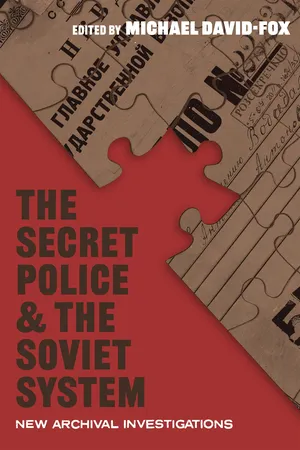
Even more than thirty years after the dissolution of the Soviet Union, the role of the secret police in shaping culture and society in communist USSR has been difficult to study, and defies our complete understanding. In the last decade, the opening of non-Russian KGB archives, notably in Ukraine after 2015, has allowed scholars to explore state security organizations in ways not previously possible. Moving beyond well-known cases of high-profile espionage and repression, this study is the first to showcase research from a wide range of secret police archives in former Soviet republics and the countries of the former Soviet bloc—some of which are rapidly closing or becoming inaccessible once again. Rather than focusing on Soviet leadership, The Secret Police and the Soviet System integrates the secret police into studies of information, technology, economics, art, and ideology. The result is a state-of-the-art portrait of one of the world's most notorious institutions, the legacies of which are directly relevant for understanding Vladimir Putin's Russia today.
- 432 pages
- English
- ePUB (mobile friendly)
- Available on iOS & Android
eBook - ePub
About this book
Information
Topic
LiteraturTable of contents
- Cover Page
- Title Page
- Copyright Page
- Contents
- List of Abbreviations
- Introduction. Into and Beyond the Stalinist Model of Secret Policing
- 1. The Origins of Stalin’s Mass Operations: The Extrajudicial Special Assembly, 1922–1953
- 2. The NKVD and the Political Origins of Socialist Realism: The Persecution of the Boichukisty in Ukraine
- 3. KGB Photography Experimentation: Turning Religion into Organized Crime
- 4. The Gulag’s “Dead Souls”: Mortality of Released Invalids in the Camps, 1930–1955
- 5. Deciphering the Stalinist Perpetrators: The Case of Georgian NKVD Investigators Khazan, Savitskii, and Krimian
- 6. “Conflicts Are the Core of Social Life”: Fomenting Mistrust at the Tallinn State Conservatory in the 1940s–1960s
- 7. Constructing Guilt and Tracking the Enemy: The Hunt for “State Criminals” in Soviet Lithuania, 1944–1953
- 8. The Mug Shot and the Close-Up: Identification and Visual Pedagogy in Secret Police Film
- 9. The Soviets Abroad: The NKVD, Intelligence, and State Building in East-Central Europe after World War II
- 10. The Black Sea Coast as a Landscape of Cold War Intelligence
- 11. Recidivism, Prophylaxis, and the KGB
- 12. Human Rights Activism as International Conspiracy: Iurii Andropov, Soviet Dissidents, and “Ideological Sabotage,” 1967–1980
- 13. Cybernetics and Surveillance: The Secret Police Enter the Computer Age
- Contributors
- Index
Trusted by 375,005 students
Access to over 1.5 million titles for a fair monthly price.
Study more efficiently using our study tools.
Frequently asked questions
Yes, you can cancel anytime from the Subscription tab in your account settings on the Perlego website. Your subscription will stay active until the end of your current billing period. Learn how to cancel your subscription
No, books cannot be downloaded as external files, such as PDFs, for use outside of Perlego. However, you can download books within the Perlego app for offline reading on mobile or tablet. Learn how to download books offline
Perlego offers two plans: Essential and Complete
- Essential is ideal for learners and professionals who enjoy exploring a wide range of subjects. Access the Essential Library with 800,000+ trusted titles and best-sellers across business, personal growth, and the humanities. Includes unlimited reading time and Standard Read Aloud voice.
- Complete: Perfect for advanced learners and researchers needing full, unrestricted access. Unlock 1.5M+ books across hundreds of subjects, including academic and specialized titles. The Complete Plan also includes advanced features like Premium Read Aloud and Research Assistant.
We are an online textbook subscription service, where you can get access to an entire online library for less than the price of a single book per month. With over 1.5 million books across 990+ topics, we’ve got you covered! Learn about our mission
Look out for the read-aloud symbol on your next book to see if you can listen to it. The read-aloud tool reads text aloud for you, highlighting the text as it is being read. You can pause it, speed it up and slow it down. Learn more about Read Aloud
Yes! You can use the Perlego app on both iOS and Android devices to read anytime, anywhere — even offline. Perfect for commutes or when you’re on the go.
Please note we cannot support devices running on iOS 13 and Android 7 or earlier. Learn more about using the app
Please note we cannot support devices running on iOS 13 and Android 7 or earlier. Learn more about using the app
Yes, you can access The Secret Police and the Soviet System by Michael David-Fox in PDF and/or ePUB format, as well as other popular books in Literatur & Europäische Literarische Sammlungen. We have over 1.5 million books available in our catalogue for you to explore.