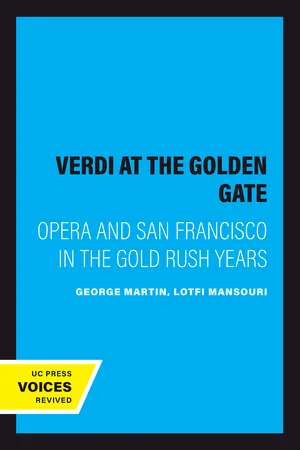
Opera is a fragile, complex art, but it flourished extravagantly in San Francisco during the Gold Rush years, a time when daily life in the city was filled with gambling, duels, murder, and suicide. In the history of the United States there has never been a rougher town than Gold Rush San Francisco, yet there has never been a greater frenzy for opera than developed there in these exciting years.
How did this madness for opera take root and grow? Why did the audience's generally drunken, brawling behavior gradually improve? How and why did Verdi emerge as the city's favorite composer? These are the intriguing themes of George Martin's enlightening and wonderfully entertaining story. Among the incidents recounted are the fist fight that stopped an opera performance and ended in a fatal duel; and the brothel madam who, by sitting in the wrong row of a theater, caused a fracas that resulted in the formation of the Vigilantes of 1856.
Martin weaves together meticulously gathered social, political, and musical facts to create this lively cultural history. His study contributes to a new understanding of urban culture in the Jacksonian–Manifest Destiny eras, and of the role of opera in cities during this time, especially in the American West. Over it all soars Verdi's somber, romantic music, capturing the melancholy, the feverish joy, and the idealism of his listeners.
Opera is a fragile, complex art, but it flourished extravagantly in San Francisco during the Gold Rush years, a time when daily life in the city was filled with gambling, duels, murder, and suicide. In the history of the United States there has never been
- 344 pages
- English
- ePUB (mobile friendly)
- Available on iOS & Android
eBook - ePub
About this book
Information
Table of contents
- Cover
- Title
- Copyright
- Contents
- Illustrations
- Foreword
- Preface
- Acknowledgments
- Prologue
- PART I
- ONE Toward a Theatre
- TWO The First Opera
- THREE The Celebrity Sopranos
- FOUR More of Emani; and the First Resident Company
- FIVE Anna Bishop and Judith (Nabucco)
- SIX Emani, Nabucco, I Lombardi, and I due Foscari
- SEVEN Economic Decline, Il trovatore in Excerpts, and the Vigilantes of 1856
- PART II
- EIGHT Maguire, His Opera House, and the Bianchis
- NINE Il trovatore Premiered; Emani Revived
- TEN The Bianchis Produce La traviata and Attila
- ELEVEN Theatrical Scenery and Styles; Traviata and the New Realism
- TWELVE A Duel, and a Period of Operatic Doldrums
- THIRTEEN Success of the Maguire-Lyster Company, and Failure of Rigoletto
- FOURTEEN The Annus mirabilis: San Francisco Mad for Opera
- Epilogue
- APPENDIX A Opera Premieres in San Francisco, 1851 Through 1860, with Theatre, Cast, and Number of Performances
- APPENDIX B Chief Theatres for Opera in San Francisco, 1851—60
- APPENDIX C Transpositions and Tuning A in San Francisco
- APPENDIX D Verdi’s Operas: World, Western Hemisphere, United States, and San Francisco Premieres, with Casts for San Francisco
- APPENDIX E Reviews of San Francisco Premieres and Early Performances of acbeth, I masnadieri, and Luisa Miller
- APPENDIX F Performances of Verdi’s Operas in San Francisco by Decade, 1851 Through 1899
- Notes
- Works Cited
- Index
Trusted by 375,005 students
Access to over 1.5 million titles for a fair monthly price.
Study more efficiently using our study tools.
Frequently asked questions
Yes, you can cancel anytime from the Subscription tab in your account settings on the Perlego website. Your subscription will stay active until the end of your current billing period. Learn how to cancel your subscription
No, books cannot be downloaded as external files, such as PDFs, for use outside of Perlego. However, you can download books within the Perlego app for offline reading on mobile or tablet. Learn how to download books offline
Perlego offers two plans: Essential and Complete
- Essential is ideal for learners and professionals who enjoy exploring a wide range of subjects. Access the Essential Library with 800,000+ trusted titles and best-sellers across business, personal growth, and the humanities. Includes unlimited reading time and Standard Read Aloud voice.
- Complete: Perfect for advanced learners and researchers needing full, unrestricted access. Unlock 1.5M+ books across hundreds of subjects, including academic and specialized titles. The Complete Plan also includes advanced features like Premium Read Aloud and Research Assistant.
We are an online textbook subscription service, where you can get access to an entire online library for less than the price of a single book per month. With over 1.5 million books across 990+ topics, we’ve got you covered! Learn about our mission
Look out for the read-aloud symbol on your next book to see if you can listen to it. The read-aloud tool reads text aloud for you, highlighting the text as it is being read. You can pause it, speed it up and slow it down. Learn more about Read Aloud
Yes! You can use the Perlego app on both iOS and Android devices to read anytime, anywhere — even offline. Perfect for commutes or when you’re on the go.
Please note we cannot support devices running on iOS 13 and Android 7 or earlier. Learn more about using the app
Please note we cannot support devices running on iOS 13 and Android 7 or earlier. Learn more about using the app
Yes, you can access Verdi at the Golden Gate by George Martin in PDF and/or ePUB format, as well as other popular books in Media & Performing Arts & Opera Music. We have over 1.5 million books available in our catalogue for you to explore.