Thinking in Pictures: Dramatic Structure in D. W. Griffith's Biograph Films by Joyce E. Jesionowski offers a rigorous reconsideration of Griffith's reputation as both pioneer and mythmaker in early cinema. While Griffith has often been credited—sometimes uncritically—with "inventing" film technique, Jesionowski situates his Biograph work within a broader international context in which many cinematic devices, from fades and dissolves to intercutting and camera movement, were already in practice. Rather than attributing to Griffith the discovery of technique, she argues that his significance lies in shaping a new relationship between film and its spectators. Griffith's Biograph films, made between 1908 and 1913, reveal an evolving consciousness of cinema as an art of construction, not simple reproduction, and demonstrate his awareness that audiences co-create meaning by filling narrative and visual gaps. For Griffith, cinematic storytelling became a contract with viewers, asking them to "see thoughts" in silence and to participate imaginatively in the drama. Jesionowski shows how Griffith refined this collaborative mode of viewing into a distinctive visual and narrative system. Through intercutting, spatial elision, and repetition of images, Griffith achieved a plausibility that critics such as Frank Woods and Hugo Münsterberg recognized as simultaneously illusionistic and constructed. The Biograph films reveal a process of learning to harness audience perception as the central engine of cinematic drama, converting movements in space into relationships between characters and emotions. Jesionowski emphasizes Griffith's ability to subjugate acting, scenery, and pictorial beauty to the larger organizational moment in which narrative coherence emerges from the arrangement of shots. In this sense, Griffith's Biograph period exemplifies cinema's departure from theater toward a unique visual medium, one defined not by invention of isolated devices but by the discovery of cinematic structure itself. Her study restores Griffith to film history not as sole inventor, but as the filmmaker who first systematically explored the principles of cinematic organization that remain foundational to narrative film. This title is part of UC Press's Voices Revived program, which commemorates University of California Press's mission to seek out and cultivate the brightest minds and give them voice, reach, and impact. Drawing on a backlist dating to 1893, Voices Revived makes high-quality, peer-reviewed scholarship accessible once again using print-on-demand technology. This title was originally published in 1987.
Many titles in the Voices Revived program are also newly available as ebooks, offered at a discounted price to support wider access to scholarly work.
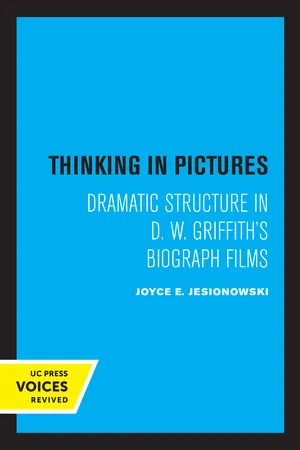
eBook - ePub
Thinking in Pictures
Dramatic Structure in D. W. Griffith's Biograph Films
- 224 pages
- English
- ePUB (mobile friendly)
- Available on iOS & Android
eBook - ePub
About this book
Information
Table of contents
- Cover
- Title
- Copyright
- Contents
- List of Illustrations
- Acknowledgments
- Introduction
- A Basic Line of Action 2
- Basic Structures 3
- A Basic Frame 4 of Reference
- The Organizational 5 Moment
- Notes
- Selected Bibliography
- Release Order of Films Discussed
- Index of Film Titles
- General Index
Trusted by 375,005 students
Access to over 1.5 million titles for a fair monthly price.
Study more efficiently using our study tools.
Frequently asked questions
Yes, you can cancel anytime from the Subscription tab in your account settings on the Perlego website. Your subscription will stay active until the end of your current billing period. Learn how to cancel your subscription
No, books cannot be downloaded as external files, such as PDFs, for use outside of Perlego. However, you can download books within the Perlego app for offline reading on mobile or tablet. Learn how to download books offline
Perlego offers two plans: Essential and Complete
- Essential is ideal for learners and professionals who enjoy exploring a wide range of subjects. Access the Essential Library with 800,000+ trusted titles and best-sellers across business, personal growth, and the humanities. Includes unlimited reading time and Standard Read Aloud voice.
- Complete: Perfect for advanced learners and researchers needing full, unrestricted access. Unlock 1.5M+ books across hundreds of subjects, including academic and specialized titles. The Complete Plan also includes advanced features like Premium Read Aloud and Research Assistant.
We are an online textbook subscription service, where you can get access to an entire online library for less than the price of a single book per month. With over 1.5 million books across 990+ topics, we’ve got you covered! Learn about our mission
Look out for the read-aloud symbol on your next book to see if you can listen to it. The read-aloud tool reads text aloud for you, highlighting the text as it is being read. You can pause it, speed it up and slow it down. Learn more about Read Aloud
Yes! You can use the Perlego app on both iOS and Android devices to read anytime, anywhere — even offline. Perfect for commutes or when you’re on the go.
Please note we cannot support devices running on iOS 13 and Android 7 or earlier. Learn more about using the app
Please note we cannot support devices running on iOS 13 and Android 7 or earlier. Learn more about using the app
Yes, you can access Thinking in Pictures by Joyce E. Jesionowski in PDF and/or ePUB format, as well as other popular books in Media & Performing Arts & Film & Video. We have over 1.5 million books available in our catalogue for you to explore.