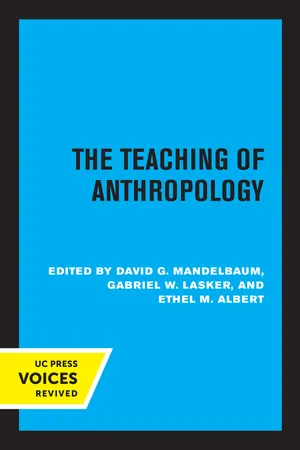
The Teaching of Anthropology (Abridged Edition), edited by David G. Mandelbaum, Gabriel W. Lasker, and Ethel M. Albert, is a landmark appraisal of how anthropology should be taught, particularly at the undergraduate level in the United States. Emerging at a moment of expanding enrollments, proliferating subfields, and growing institutional demands, the volume grapples with the central pedagogical challenge of transmitting anthropology's unique culture of inquiry. Its contributors argue that anthropology's value lies in its holistic scope, its grounding in field research, and its insistence on viewing human variation through scientific method—qualities that not only illuminate diverse peoples but also provide students with transferable analytic habits for understanding their own world. The collection ranges across the major subfields—biological, archaeological, linguistic, and cultural/social anthropology—while also treating applied anthropology, graduate training, and the discipline's broader academic context. Essays emphasize the unity of anthropology through the central concept of culture, advocate for carefully chosen case studies to balance scope with depth, and show how applied and comparative studies can clarify theory. With a focus on practical teaching concerns—curricular sequencing, course design, and coordination within expanding departments—the book demonstrates how anthropology can remain scientifically rigorous, pedagogically compelling, and socially relevant. In presenting both points of consensus and unresolved debates, it provides a foundational guide for instructors, departments, and planners committed to sustaining anthropology's vitality in higher education. This title is part of UC Press's Voices Revived program, which commemorates University of California Press's mission to seek out and cultivate the brightest minds and give them voice, reach, and impact. Drawing on a backlist dating to 1893, Voices Revived makes high-quality, peer-reviewed scholarship accessible once again using print-on-demand technology. This title was originally published in 1963.
Many titles in the Voices Revived program are also newly available as ebooks, offered at a discounted price to support wider access to scholarly work.
eBook - ePub
The Teaching of Anthropology, Abridged Edition
- 408 pages
- English
- ePUB (mobile friendly)
- Available on iOS & Android
eBook - ePub
The Teaching of Anthropology, Abridged Edition
About this book
Information
Table of contents
- Cover
- Title
- Copyright
- Contents
- DAVID G. MANDELBAUM The Transmission of Anthropological Culture
- Introduction
- CORA DU BOIS The Curriculum in Cultural Anthropology
- SHERWOOD L. WASHBURN The Curriculum in Physical Anthropology
- DAVID G. MANDELBAUM A Design for an Anthropology Curriculum
- Introduction
- FREDERICK S. HULSE Objectives and
- WILLIAM S. LAUGHLIN Concepts and Problems
- GABRIEL W. LASKER The Introductory
- Introduction
- RAYMOND FIRTH Aims, Methods, and Concepts in the Teaching of Social Anthropology
- EDWARD M. BRUNER AND GEORGE D. SPINDLER with the assistance of Fred H. Werner The Introductory Course in Cultural Anthropology
- DAVID H. FRENCH The Role of Anthropologist in the Methodology of Teaching
- Introduction
- EVON Z. VOGT Courses of Regional Scope
- JOHN W. BENNETT A Course in Comparative Civilizations
- Introduction
- RICHARD B. WOODBURY Purposes and Concepts
- ALFRED KIDDER II Course Design
- ROBERT J. BRAIDWOOD Themes and Course Progression
- Introduction
- DELL H. HYMES Objectives and Concepts of Linguistic Anthropology
- Introduction
- ROBERT N. RAPOPORT Aims and Methods
- KENNETH LITTLE The Context of Social Change1
- RICHARD N. ADAMS General Use of Studies in Applied Anthropology
- Introduction
- FRED EGGAN The Graduate Program
- MEYER FORTES Graduate Study and Research
- Introduction
- JOSEPH B. CASAGRANDE The Relations of Anthropology with the Social Sciences
- J. N. SPUHLER AND F. B. LIVINGSTONE The Relations of Physical Anthropology with the Biological Sciences
- Comments on Academic Environments in the Teaching of Anthropology
- Introduction
- ETHEL M. ALBERT Value Aspects of Teaching Anthropology
- ROBERT W. EHRICH Anthropology as an Integrative Factor
- MARGARET MEAD Anthropology and an Education for the Future
- Index
Trusted by 375,005 students
Access to over 1.5 million titles for a fair monthly price.
Study more efficiently using our study tools.
Frequently asked questions
Yes, you can cancel anytime from the Subscription tab in your account settings on the Perlego website. Your subscription will stay active until the end of your current billing period. Learn how to cancel your subscription
No, books cannot be downloaded as external files, such as PDFs, for use outside of Perlego. However, you can download books within the Perlego app for offline reading on mobile or tablet. Learn how to download books offline
Perlego offers two plans: Essential and Complete
- Essential is ideal for learners and professionals who enjoy exploring a wide range of subjects. Access the Essential Library with 800,000+ trusted titles and best-sellers across business, personal growth, and the humanities. Includes unlimited reading time and Standard Read Aloud voice.
- Complete: Perfect for advanced learners and researchers needing full, unrestricted access. Unlock 1.5M+ books across hundreds of subjects, including academic and specialized titles. The Complete Plan also includes advanced features like Premium Read Aloud and Research Assistant.
We are an online textbook subscription service, where you can get access to an entire online library for less than the price of a single book per month. With over 1.5 million books across 990+ topics, we’ve got you covered! Learn about our mission
Look out for the read-aloud symbol on your next book to see if you can listen to it. The read-aloud tool reads text aloud for you, highlighting the text as it is being read. You can pause it, speed it up and slow it down. Learn more about Read Aloud
Yes! You can use the Perlego app on both iOS and Android devices to read anytime, anywhere — even offline. Perfect for commutes or when you’re on the go.
Please note we cannot support devices running on iOS 13 and Android 7 or earlier. Learn more about using the app
Please note we cannot support devices running on iOS 13 and Android 7 or earlier. Learn more about using the app
Yes, you can access The Teaching of Anthropology, Abridged Edition by David G. Mandelbaum,Gabriel W. Lasker,Ethel M. Albert in PDF and/or ePUB format, as well as other popular books in Education & Teaching Social Science. We have over 1.5 million books available in our catalogue for you to explore.