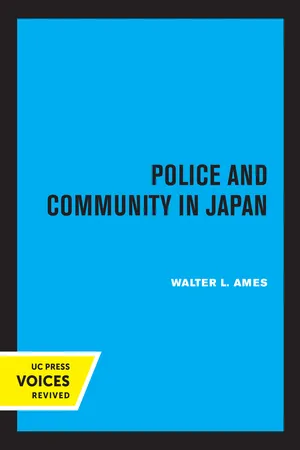
Police and Community in Japan explores the intricate relationship between the Japanese police force and the society it serves, offering a comprehensive examination of how law enforcement operates within one of the safest countries in the world. The book delves into the remarkable adaptability of the Japanese police as they navigate diverse societal contexts—rural, urban, and industrial—while addressing unique challenges presented by social groups such as youth, minorities, and organized crime. Through a dual focus on the formal ideals (tatemae) and the underlying realities (honne) of police practices, the work provides a nuanced portrayal of how the police fit seamlessly into Japan's tightly woven societal fabric, balancing community collaboration with the demands of public order and security. The study is centered on Okayama Prefecture, a microcosm of Japan's evolving socio-economic landscape, incorporating traditional agricultural communities, industrial complexes, and urban centers. By focusing on specific locations such as Kurashiki City and Mizushima, the author captures the police's tailored approaches to varied environments and clienteles. Historical insights into the development of the Japanese police—tracing back to the Edo period's samurai-led social control systems—provide a rich backdrop for understanding contemporary practices. With a focus on the balance between solidarity within the police force and their integration with community needs, the book paints a dynamic picture of law enforcement in Japan, making it an essential read for those interested in comparative policing, Japanese society, and the interplay between tradition and modernization. This title is part of UC Press's Voices Revived program, which commemorates University of California Press's mission to seek out and cultivate the brightest minds and give them voice, reach, and impact. Drawing on a backlist dating to 1893, Voices Revived makes high-quality, peer-reviewed scholarship accessible once again using print-on-demand technology. This title was originally published in 1981.
Many titles in the Voices Revived program are also newly available as ebooks, offered at a discounted price to support wider access to scholarly work.
- 266 pages
- English
- ePUB (mobile friendly)
- Available on iOS & Android
eBook - ePub
Police and Community in Japan
About this book
Information
Publisher
University of California PressYear
1981Print ISBN
9780520332287
Edition
1eBook ISBN
9780520332294
Table of contents
- Cover
- Title
- Copyright
- CONTENTS 1
- PREFACE
- INTRODUCTION
- one POLICING THE RURAL COMMUNITY THE CHÜZAISHO
- two KEEPING ORDER IN THE URBAN CONTEXT THE KÕBAN
- three ADJUSTING TO A CHANGING SOCIETY
- four CONFRONTING YOUTH
- five DEALING WITH SOCIETY’S OUTCASTES
- six POLICE AND ORGANIZED CRIME
- seven
- eight THE MAKING OF POLICE OFFICERS
- nine SOLIDARITY IN THE FRONT LINE
- ten CONCLUDING REMARKS
- GLOSSARY OF SELECTED TERMS
- BIBLIOGRAPHY
- INDEX
Trusted by 375,005 students
Access to over 1.5 million titles for a fair monthly price.
Study more efficiently using our study tools.
Frequently asked questions
Yes, you can cancel anytime from the Subscription tab in your account settings on the Perlego website. Your subscription will stay active until the end of your current billing period. Learn how to cancel your subscription
No, books cannot be downloaded as external files, such as PDFs, for use outside of Perlego. However, you can download books within the Perlego app for offline reading on mobile or tablet. Learn how to download books offline
Perlego offers two plans: Essential and Complete
- Essential is ideal for learners and professionals who enjoy exploring a wide range of subjects. Access the Essential Library with 800,000+ trusted titles and best-sellers across business, personal growth, and the humanities. Includes unlimited reading time and Standard Read Aloud voice.
- Complete: Perfect for advanced learners and researchers needing full, unrestricted access. Unlock 1.5M+ books across hundreds of subjects, including academic and specialized titles. The Complete Plan also includes advanced features like Premium Read Aloud and Research Assistant.
We are an online textbook subscription service, where you can get access to an entire online library for less than the price of a single book per month. With over 1.5 million books across 990+ topics, we’ve got you covered! Learn about our mission
Look out for the read-aloud symbol on your next book to see if you can listen to it. The read-aloud tool reads text aloud for you, highlighting the text as it is being read. You can pause it, speed it up and slow it down. Learn more about Read Aloud
Yes! You can use the Perlego app on both iOS and Android devices to read anytime, anywhere — even offline. Perfect for commutes or when you’re on the go.
Please note we cannot support devices running on iOS 13 and Android 7 or earlier. Learn more about using the app
Please note we cannot support devices running on iOS 13 and Android 7 or earlier. Learn more about using the app
Yes, you can access Police and Community in Japan by Walter Lansing Ames in PDF and/or ePUB format, as well as other popular books in Law & Administrative Law. We have over 1.5 million books available in our catalogue for you to explore.