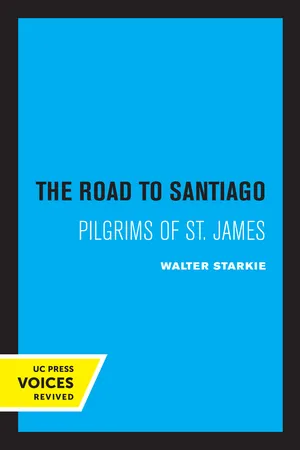
Walter Starkie's The Road to Santiago: Pilgrims of St. James is both an erudite cultural history and an ethnographically alert travel narrative of Europe's most consequential medieval pilgrimage. Framing the Camino as a "double journey" through space and time, Starkie reconstructs the institutional and imaginative worlds that accrued after the ninth-century "discovery" of the Apostle's tomb: Cluniac liturgical reform and its trans-Pyrenean networks; the *Codex Calixtinus* and Aimeric Picaud's guidebook; and the legal, charitable, and architectural infrastructures—hospitals, confraternities, markets—that naturalized mobility. He reads the road as a corridor of aesthetic exchange, synthesizing Emile Mâle and Kingsley Porter to show how Islamic ornament, Romanesque programs, and urban façades from Cluny to Paris inscribe the epic of Santiago. Starkie's archive ranges across chansons de geste and chronicles, royal itineraries and monastic records, miracle collections, and popular song, yielding a social history of devotion that encompasses Moor and Christian minstrels, Alfonso X's courtly tolerance, and the martial mythography of *Santiago Matamoros*. Attentive to practice as well as myth, he recovers material cultures of travel (from barrels and frypans to scallop shells) and the performative pedagogy of mendicancy, music, and ritual. Interleaving these sources with field diaries from four twentieth-century pilgrimages (1924–1954), Starkie stages a reflexive dialogue between medieval prescription and modern experience. He retraces Picaud's route to assess continuity and rupture in liturgy, landscape, hospitality, and popular religiosity, while juxtaposing clerical reformers, elite tourists, and "raggle-taggle" jongleurs with figures like Andrew Boorde, Montaigne, and George Borrow. The result is a methodologically plural account—part philology, part folklore, part performance studies—that treats the Camino as a laboratory for studying European connectivity, confessional politics, vernacular poetics, and memory. Specialists in medieval studies, Iberian history, and pilgrimage studies will value Starkie's capacious sourcing and his argument that the Camino's enduring appeal lies in its capacity to bind institutional Christianity, intercultural exchange, and the ordinary technologies of travel into a durable moral and aesthetic economy. This title is part of UC Press's Voices Revived program, which commemorates University of California Press's mission to seek out and cultivate the brightest minds and give them voice, reach, and impact. Drawing on a backlist dating to 1893, Voices Revived makes high-quality, peer-reviewed scholarship accessible once again using print-on-demand technology. This title was originally published in 1957.
Many titles in the Voices Revived program are also newly available as ebooks, offered at a discounted price to support wider access to scholarly work.
- 362 pages
- English
- ePUB (mobile friendly)
- Available on iOS & Android
eBook - ePub
About this book
Information
Publisher
University of California PressYear
1957Print ISBN
9780520332539
Edition
1eBook ISBN
9780520332546
Table of contents
- Cover
- Title
- Copyright
- CONTENTS
- INTROIT
- Part One EARLY PILGRIMS
- CHAPTER 2
- Part Two A MODERN PILGRIM
- INDEX
Trusted by 375,005 students
Access to over 1.5 million titles for a fair monthly price.
Study more efficiently using our study tools.
Frequently asked questions
Yes, you can cancel anytime from the Subscription tab in your account settings on the Perlego website. Your subscription will stay active until the end of your current billing period. Learn how to cancel your subscription
No, books cannot be downloaded as external files, such as PDFs, for use outside of Perlego. However, you can download books within the Perlego app for offline reading on mobile or tablet. Learn how to download books offline
Perlego offers two plans: Essential and Complete
- Essential is ideal for learners and professionals who enjoy exploring a wide range of subjects. Access the Essential Library with 800,000+ trusted titles and best-sellers across business, personal growth, and the humanities. Includes unlimited reading time and Standard Read Aloud voice.
- Complete: Perfect for advanced learners and researchers needing full, unrestricted access. Unlock 1.5M+ books across hundreds of subjects, including academic and specialized titles. The Complete Plan also includes advanced features like Premium Read Aloud and Research Assistant.
We are an online textbook subscription service, where you can get access to an entire online library for less than the price of a single book per month. With over 1.5 million books across 990+ topics, we’ve got you covered! Learn about our mission
Look out for the read-aloud symbol on your next book to see if you can listen to it. The read-aloud tool reads text aloud for you, highlighting the text as it is being read. You can pause it, speed it up and slow it down. Learn more about Read Aloud
Yes! You can use the Perlego app on both iOS and Android devices to read anytime, anywhere — even offline. Perfect for commutes or when you’re on the go.
Please note we cannot support devices running on iOS 13 and Android 7 or earlier. Learn more about using the app
Please note we cannot support devices running on iOS 13 and Android 7 or earlier. Learn more about using the app
Yes, you can access Road to Santiago by Walter Starkie in PDF and/or ePUB format, as well as other popular books in History & European History. We have over 1.5 million books available in our catalogue for you to explore.