Gratian's Decretum, completed around 1140, represents a monumental development in the history of canon law and Christian political theory. As the foundational text for a new, systematic approach to Church law, Gratian's work combined the ancient canons with innovative scholastic methods, reconciling contradictions and offering a cohesive legal framework. This Concordia discordantium canonum (Concordance of Discordant Canons) not only became the cornerstone for the study and practice of canon law but also influenced the broader legal and governmental systems of medieval Europe. The Decretum introduced methodological rigor reminiscent of Abelard's scholastic theology, creating a system for resolving conflicting canons through distinctions and contextual interpretations. Gratian's work was pivotal in shaping the legal culture of the Church, establishing him as the "father of the science of canon law." This study delves into the Decretum's historical context, arguing that its significance extends beyond its intellectual contributions to include its engagement with the political and ecclesiastical dynamics of the mid-twelfth century. Gratian's efforts coincided with critical developments in Church reform, the assertion of papal authority, and debates over the relationship between spiritual and secular powers. Far from being an isolated academic exercise, the Decretum reflects a deliberate attempt to create a Christian theory of societal structure and governance. By considering its original purpose and comparing it with contemporary works, this analysis positions the Decretum as a key document in understanding the interplay of law, theology, and politics in medieval Christendom. Through this lens, Gratian's work emerges not only as a legal text but as a significant contribution to the theory and practice of ecclesiastical and political order. This title is part of UC Press's Voices Revived program, which commemorates University of California Press's mission to seek out and cultivate the brightest minds and give them voice, reach, and impact. Drawing on a backlist dating to 1893, Voices Revived makes high-quality, peer-reviewed scholarship accessible once again using print-on-demand technology. This title was originally published in 1972.
Many titles in the Voices Revived program are also newly available as ebooks, offered at a discounted price to support wider access to scholarly work.
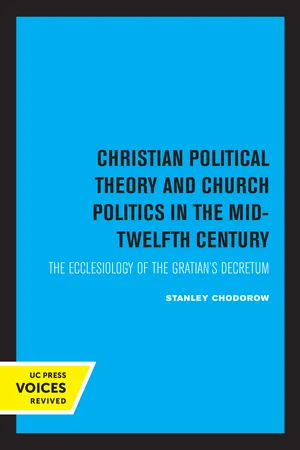
eBook - ePub
Christian Political Theory and Church Politics in the Mid-Twelfth Century
The Ecclesiology of the Gratian's Decretum
- 312 pages
- English
- ePUB (mobile friendly)
- Available on iOS & Android
eBook - ePub
Christian Political Theory and Church Politics in the Mid-Twelfth Century
The Ecclesiology of the Gratian's Decretum
About this book
Information
Publisher
University of California PressYear
1972Print ISBN
9780520333451
Edition
1eBook ISBN
9780520333468
Table of contents
- Cover
- Title
- Copyright
- Contents 1
- Abbreviations
- I. Introduction
- II. Gratian and Church Politics
- III. The Church as a Juridical Community
- IV. Human Authority and the Hierarchy of Law
- V. Human Authority and the Divine Law
- VI. Human Authority and Its Own Law: The Theory of Legislative Power
- VII. Sacerdotal Power and the Hierarchy of the Church
- VIII. The Source of Legitimate Authority in the Church
- IX. The Division of Governmental Responsibilities Between Regnum and Sacerdotium: The Ecclesiastical Community and Other Communities
- X. Conclusions
- Appendix I The Date of the Decretum
- Appendix II Saint Bernard and the Law
- Bibliography
- Index
Trusted by 375,005 students
Access to over 1.5 million titles for a fair monthly price.
Study more efficiently using our study tools.
Frequently asked questions
Yes, you can cancel anytime from the Subscription tab in your account settings on the Perlego website. Your subscription will stay active until the end of your current billing period. Learn how to cancel your subscription
No, books cannot be downloaded as external files, such as PDFs, for use outside of Perlego. However, you can download books within the Perlego app for offline reading on mobile or tablet. Learn how to download books offline
Perlego offers two plans: Essential and Complete
- Essential is ideal for learners and professionals who enjoy exploring a wide range of subjects. Access the Essential Library with 800,000+ trusted titles and best-sellers across business, personal growth, and the humanities. Includes unlimited reading time and Standard Read Aloud voice.
- Complete: Perfect for advanced learners and researchers needing full, unrestricted access. Unlock 1.5M+ books across hundreds of subjects, including academic and specialized titles. The Complete Plan also includes advanced features like Premium Read Aloud and Research Assistant.
We are an online textbook subscription service, where you can get access to an entire online library for less than the price of a single book per month. With over 1.5 million books across 990+ topics, we’ve got you covered! Learn about our mission
Look out for the read-aloud symbol on your next book to see if you can listen to it. The read-aloud tool reads text aloud for you, highlighting the text as it is being read. You can pause it, speed it up and slow it down. Learn more about Read Aloud
Yes! You can use the Perlego app on both iOS and Android devices to read anytime, anywhere — even offline. Perfect for commutes or when you’re on the go.
Please note we cannot support devices running on iOS 13 and Android 7 or earlier. Learn more about using the app
Please note we cannot support devices running on iOS 13 and Android 7 or earlier. Learn more about using the app
Yes, you can access Christian Political Theory and Church Politics in the Mid-Twelfth Century by Stanley Chodorow in PDF and/or ePUB format, as well as other popular books in Politics & International Relations & Political History & Theory. We have over 1.5 million books available in our catalogue for you to explore.