Ronald C. Tobey tells a new origin story for American ecology by relocating its birth from the campfire of nature romanticism to the laboratories, land-grant classrooms, and wind-scoured prairies of the Midwest. Saving the Prairies follows the founding school of plant ecologists—C. E. Bessey, Roscoe Pound, Frederic Clements, John E. Weaver, Paul Sears—whose shared apprenticeship and field experience forged a tightly knit research community and a powerful scientific paradigm: plant succession. From the sod-busting 1890s through the Dust Bowl and New Deal, Tobey shows how their theory migrated from botany into policy, shaping forest reserves, game management, agricultural programs, and, later, the language of environmental impact. Lyrical evocations of tallgrass resilience sit alongside debates over measurement, experiment, and utility, revealing how the prairies functioned simultaneously as object of study, moral touchstone, and political symbol. Rejecting a simple history of ideas, Tobey offers a case study in scientific change—what he calls a microparadigm—guided by Kuhn and informed by the sociology of science. He reconstructs how the Nebraska-centered network secured intellectual authority through graduate training, institutional placement, coauthorship, and citation, and how the same social bonds constrained critical testing of cherished assumptions. The book's pivot comes in the 1930s, when drought and economic crisis exposed the limits of an "inevitably progressive" succession and redirected the field toward active management; even allies like A. G. Tansley peeled away as philosophical and political winds shifted. Through meticulous archival work and innovative quantitative analysis, Saving the Prairies demonstrates that ecological knowledge is inseparable from institutional settings and civic purposes. It is both an intimate group biography and a bracing account of how a science that once promised to "approach the eternal" learned instead to live with contingency—and, in doing so, helped invent modern environmentalism. This title is part of UC Press's Voices Revived program, which commemorates University of California Press's mission to seek out and cultivate the brightest minds and give them voice, reach, and impact. Drawing on a backlist dating to 1893, Voices Revived makes high-quality, peer-reviewed scholarship accessible once again using print-on-demand technology. This title was originally published in 1981.
Many titles in the Voices Revived program are also newly available as ebooks, offered at a discounted price to support wider access to scholarly work.
eBook - ePub
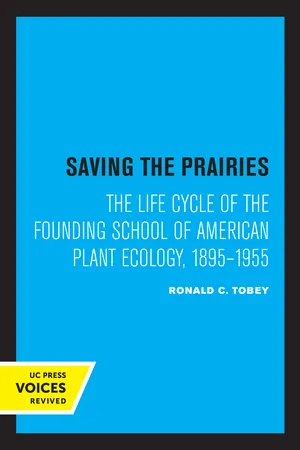
Saving the Prairies
The Life Cycle of the Founding School of American Plant Ecology, 1895-1955
- 326 pages
- English
- ePUB (mobile friendly)
- Available on iOS & Android
eBook - ePub
Saving the Prairies
The Life Cycle of the Founding School of American Plant Ecology, 1895-1955
About this book
Information
Publisher
University of California PressYear
1981Print ISBN
9780520371323
Edition
1eBook ISBN
9780520334205
Table of contents
- Cover
- Title
- Copyright
- CONTENTS
- ACKNOWLEDGMENTS
- INTRODUCTION
- 1 MISSIONARIES FOR BOTANY: C. E. Bessey and His Students
- 2 THE CREATIVE TENSION: Laboratory Versus Nature Study
- 3 QUADRAT: Quantitative Methods for Ecology
- 4 FREDERIC CLEMENTS'S Theory of Plant Succession
- 5 THE LIFE CYCLE OF GRASSLAND ECOLOGY
- 6 A. G. TANSLEY: A British Critic of Clementsian Theory, 1905—1935
- 7 SAVING THE PRAIRIES: The Great Drought of the 1930s and the Climax of the Grassland School
- METHODOLOGICAL APPENDIX
- NOTES
- BIBLIOGRAPHY
- INDEX
Trusted by 375,005 students
Access to over 1.5 million titles for a fair monthly price.
Study more efficiently using our study tools.
Frequently asked questions
Yes, you can cancel anytime from the Subscription tab in your account settings on the Perlego website. Your subscription will stay active until the end of your current billing period. Learn how to cancel your subscription
No, books cannot be downloaded as external files, such as PDFs, for use outside of Perlego. However, you can download books within the Perlego app for offline reading on mobile or tablet. Learn how to download books offline
Perlego offers two plans: Essential and Complete
- Essential is ideal for learners and professionals who enjoy exploring a wide range of subjects. Access the Essential Library with 800,000+ trusted titles and best-sellers across business, personal growth, and the humanities. Includes unlimited reading time and Standard Read Aloud voice.
- Complete: Perfect for advanced learners and researchers needing full, unrestricted access. Unlock 1.5M+ books across hundreds of subjects, including academic and specialized titles. The Complete Plan also includes advanced features like Premium Read Aloud and Research Assistant.
We are an online textbook subscription service, where you can get access to an entire online library for less than the price of a single book per month. With over 1.5 million books across 990+ topics, we’ve got you covered! Learn about our mission
Look out for the read-aloud symbol on your next book to see if you can listen to it. The read-aloud tool reads text aloud for you, highlighting the text as it is being read. You can pause it, speed it up and slow it down. Learn more about Read Aloud
Yes! You can use the Perlego app on both iOS and Android devices to read anytime, anywhere — even offline. Perfect for commutes or when you’re on the go.
Please note we cannot support devices running on iOS 13 and Android 7 or earlier. Learn more about using the app
Please note we cannot support devices running on iOS 13 and Android 7 or earlier. Learn more about using the app
Yes, you can access Saving the Prairies by Ronald C. Tobey in PDF and/or ePUB format, as well as other popular books in History & North American History. We have over 1.5 million books available in our catalogue for you to explore.