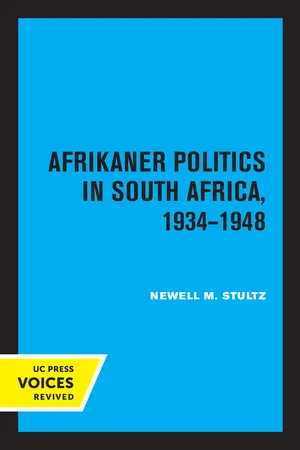
This book examines the political landscape of South Africa from 1934 to 1948, focusing on the ideological conflict between Afrikaner nationalism and policies aimed at conciliation between Afrikaners and English-speaking South Africans. The Union of South Africa, founded in 1910, unified the country under a government heavily influenced by British principles but also included leaders from the former Boer republics. Early South African politics became a struggle between two major political ideologies: one that promoted Afrikaner nationalism, advocating for Afrikaner cultural and political interests, and another that supported "conciliation," a philosophy attempting to bridge ethnic divides and foster unity among white South Africans. The book highlights that conciliation parties faced significant challenges in gaining long-term Afrikaner support, as they needed to balance competing interests between English-speaking South Africans and Afrikaners, who felt a strong sense of ethnic identity. Afrikaner nationalist parties, however, did not need this balance and could draw on the deep-seated solidarity within their community. The critical turning point in this era, according to the author, was Prime Minister Jan Smuts' decision in 1939 to align South Africa with Britain in declaring war on Germany. This move alienated a large portion of the Afrikaner electorate, who saw it as a violation of the "South Africa first" principle and contributed significantly to the United Party's waning support. This estrangement between Afrikaners and conciliation parties, the author argues, set the stage for the rise of the National Party and their victory in 1948, which marked the start of apartheid. While many observers attributed the Nationalist victory to the appeal of apartheid policies, this study suggests that the National Party's success stemmed more fundamentally from the longstanding disillusionment with conciliation policies and the failure of conciliation leaders to create "integrative" solutions that resonated with both Afrikaners and English-speaking South Africans. This historical analysis sheds light on how ethnic divisions and unresolved political conflicts laid the groundwork for South Africa's mid-20th-century shift toward Afrikaner-dominated governance. This title is part of UC Press's Voices Revived program, which commemorates University of California Press's mission to seek out and cultivate the brightest minds and give them voice, reach, and impact. Drawing on a backlist dating to 1893, Voices Revived makes high-quality, peer-reviewed scholarship accessible once again using print-on-demand technology. This title was originally published in 1974.
Many titles in the Voices Revived program are also newly available as ebooks, offered at a discounted price to support wider access to scholarly work.
- 212 pages
- English
- ePUB (mobile friendly)
- Available on iOS & Android
eBook - ePub
Afrikaner Politics in South Africa, 1934-1948
About this book
Information
Publisher
University of California PressYear
1974Print ISBN
9780520371910
Edition
1eBook ISBN
9780520335202
Table of contents
- Cover
- Title
- Copyright
- Contents
- Preface
- Introduction
- 1.The Power of Afrikaner Unity
- Fusion
- 3.Right Versus Center
- 4* End of Fusion
- 5.1943: Electoral Amplification
- 6.Some Demographic Changes
- 7.Turn of the Tide
- 8.The 1948 Elections
- 9.Epilogue: 1948 to 1970
- Selected Bibliography
- Index
Trusted by 375,005 students
Access to over 1.5 million titles for a fair monthly price.
Study more efficiently using our study tools.
Frequently asked questions
Yes, you can cancel anytime from the Subscription tab in your account settings on the Perlego website. Your subscription will stay active until the end of your current billing period. Learn how to cancel your subscription
No, books cannot be downloaded as external files, such as PDFs, for use outside of Perlego. However, you can download books within the Perlego app for offline reading on mobile or tablet. Learn how to download books offline
Perlego offers two plans: Essential and Complete
- Essential is ideal for learners and professionals who enjoy exploring a wide range of subjects. Access the Essential Library with 800,000+ trusted titles and best-sellers across business, personal growth, and the humanities. Includes unlimited reading time and Standard Read Aloud voice.
- Complete: Perfect for advanced learners and researchers needing full, unrestricted access. Unlock 1.5M+ books across hundreds of subjects, including academic and specialized titles. The Complete Plan also includes advanced features like Premium Read Aloud and Research Assistant.
We are an online textbook subscription service, where you can get access to an entire online library for less than the price of a single book per month. With over 1.5 million books across 990+ topics, we’ve got you covered! Learn about our mission
Look out for the read-aloud symbol on your next book to see if you can listen to it. The read-aloud tool reads text aloud for you, highlighting the text as it is being read. You can pause it, speed it up and slow it down. Learn more about Read Aloud
Yes! You can use the Perlego app on both iOS and Android devices to read anytime, anywhere — even offline. Perfect for commutes or when you’re on the go.
Please note we cannot support devices running on iOS 13 and Android 7 or earlier. Learn more about using the app
Please note we cannot support devices running on iOS 13 and Android 7 or earlier. Learn more about using the app
Yes, you can access Afrikaner Politics in South Africa, 1934-1948 by Newell M. Stultz in PDF and/or ePUB format, as well as other popular books in History & African History. We have over 1.5 million books available in our catalogue for you to explore.